0
0€
Your cart is empty
You have no items in your cart

An antiquarian book is first and foremost valued for its text, its edition and its condition. Sometimes it bears an additional mark: a coat of arms stamped on the boards, an ex-libris pasted on the inside cover, or a sale number pencilled in. These provenances tell the story of great French bibliophiles, from Jean Grolier to the Duke of Aumale and Louis Barthou, and they influence the price. Here is who they were, what became of their libraries, and what their traces add to an individual copy.
Born in Lyon in 1479 and died in Paris in 1565, Jean Grolier was Treasurer of France and of Milan. His library is estimated at around 3,000 volumes; some five hundred of his bindings have survived, many from the workshop of Jean Picard.
On the boards, he had Io. Grolierii et amicorum gilded, “of Jean Grolier and his friends”, or a motto taken from a psalm, Portio mea Domine sit in terra viventium. The phrase conveys a way of owning books in order to share them. The Grolier Club, a bibliophilic society founded in New York in 1884, still bears his name.
The historian and magistrate Jacques-Auguste de Thou (1553–1617) assembled around one thousand manuscripts and eight thousand printed books, all bound with his arms. His library, open to students and foreign scholars, remained unrivalled in Paris until the mid-17th century.
His story illustrates how a provenance is formed. Kept by his children, almost entirely repurchased in 1680 by the president de Ménars, later passing to the Rohan-Soubise, it was dispersed in 1789. A single volume may thus carry the arms of de Thou and the traces of successive owners.
Richelieu gathered more than six thousand volumes at the Palais-Cardinal, now the Palais-Royal, and some 250 at the château de Rueil, through systematic purchases as well as seizures. His bindings bear his arms, silver with three red chevrons beneath the cardinal’s hat.
In 1643 Mazarin commissioned Gabriel Naudé, author of an Advis pour dresser une bibliothèque published in 1627, to build his Parisian library, opened to readers that same year. During the Fronde, the Parlement ordered its sale from 8 January to 17 February 1652. The cardinal reconstituted it and bequeathed it in 1661 to the Collège des Quatre-Nations, which he founded by testament; reopened in 1689, the Mazarine presents itself as France’s oldest public library.
Henri d’Orléans, Duke of Aumale (1822–1897), fifth son of Louis-Philippe, inherited Chantilly and the Condé fortune at the age of eight, through his godfather, the last Prince of Condé. Exiled in England in 1848, he installed his collections at Orleans House near Twickenham and bought books for forty years.
He purchased entire libraries in bulk: the 3,504 volumes of the Standish collection in 1851, followed by that of Armand Cigongne, paid for at 375,000 francs even before it went on sale. He also hunted down copies of notable provenance, such as an Aristophanes once owned by Rabelais, acquired in 1853, or Montaigne’s Commentaries on Caesar, purchased in 1856.
In 1856, he also bought the Très Riches Heures of the Duke of Berry in Italy; it was Léopold Delisle of the Bibliothèque nationale who identified in 1881 the manuscript with the “Très Riches Heures” described in the duke’s inventory. In 1891, he paid 250,000 francs to the Brentano family of Frankfurt for forty miniatures by Jean Fouquet taken from the Hours of Étienne Chevalier.
In 1886, he donated Chantilly and its collections to the Institut de France, reserving for himself the usufruct under three conditions: that the museum be open to the public, that its presentation remain as he had designed it, and that nothing be lent out. The Musée Condé opened on 17 April 1898. His book room, fitted out in 1876–1877 by the architect Honoré Daumet, holds some 1,500 manuscripts, including 200 illuminated ones, and thousands of rare printed works.
Born in Oloron-Sainte-Marie in 1862, Louis Barthou served multiple terms as a minister, was Prime Minister in 1913, and was elected to the Académie française in 1918. He was also a great bibliophile. Léopold Carteret, whose bibliographical directories remain a standard reference, considered his library “one of the finest and most vibrant of his time.”
An admirer of Romantic editions and manuscripts, he had his copies bound by the finest workshops, Gruel or Marius Michel, and affixed an ex-libris designed by Boutet de Monvel. He published several books rich in unpublished documents, including Les Amours d’un poète, on Victor Hugo. Edmond Rostand presented him with plays printed on coloured paper, issued in a few copies for friends, with dedications such as that on this Aiglon:
“To Louis Barthou, minister, bibliophile, and Pyrenean.”
Edmond Rostand, Cambo, 1908.
His son had fallen at the front in 1914. Barthou himself was fatally wounded in Marseille on 9 October 1934 during the assassination that also claimed the life of King Alexander I of Yugoslavia. His library was sold in four parts, from March 1935 to June 1936, through catalogues issued by the Blaizot firm; booksellers still refer to the “Barthou sale” followed by the lot number. Charles Maurras had devoted a book to him in 1929, Le Bibliophile Barthou.
When a great library is dispersed, its catalogue remains. Those of Cigongne, Barthou, Raphaël Esmerian, or Baron James de Rothschild—this last compiled by Émile Picot—have become working tools: they provide the description of a copy, sometimes its illustration, and the prices when recorded.
The Esmerian sale, held at the Palais Galliera on 6 June 1972, featured bindings bearing the arms of François Ier, Henri II, Richelieu, Colbert or Madame de Pompadour, alongside volumes from Grolier and De Thou. These catalogues themselves are collectable, ranging from a few tens to several hundred euros depending on the sale.
A distinguished provenance lends a verifiable history to a book. When proven, on a fine copy, it can multiply its price; it does not compensate for an incomplete volume or a poorly restored binding.
The evidence matters as much as the name: identified arms in the Olivier, Hermal and Roton directory, ex-libris, sale numbers, or mention in an old catalogue. Beware of arms added later to a binding unrelated to the owner, or an ex-libris pasted into a book published after the owner’s death. Our guide to ex-libris, armorial bindings and stamps explains the method, and the one on ex-libris of the French nobility presents the principal families.
A modest but documented provenance retains its interest too. A copy once owned by a local scholar, annotated in their hand, often reveals much about a book’s life.
Sale catalogues, almanacs and bibliophile journals, armorial bindings, ex-libris, books on Chantilly: this selection from our stock is updated with every new acquisition.
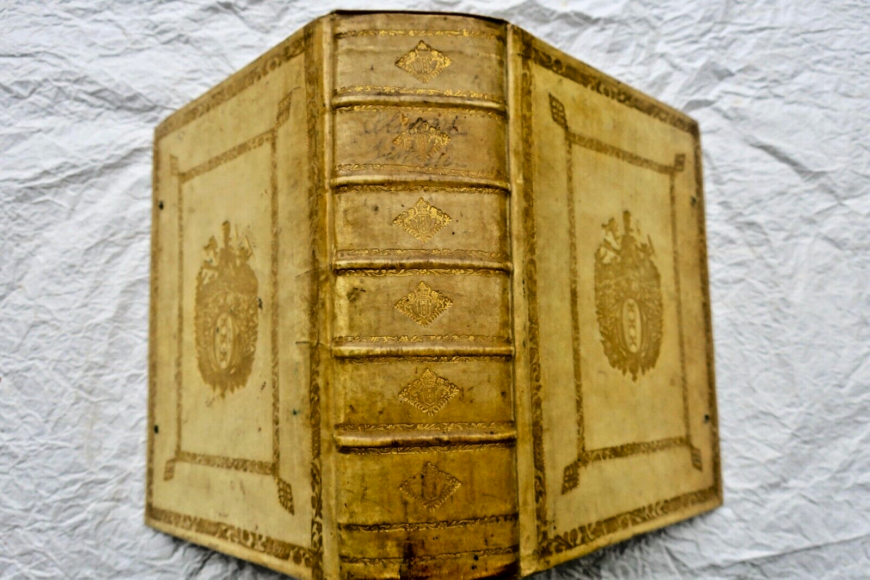
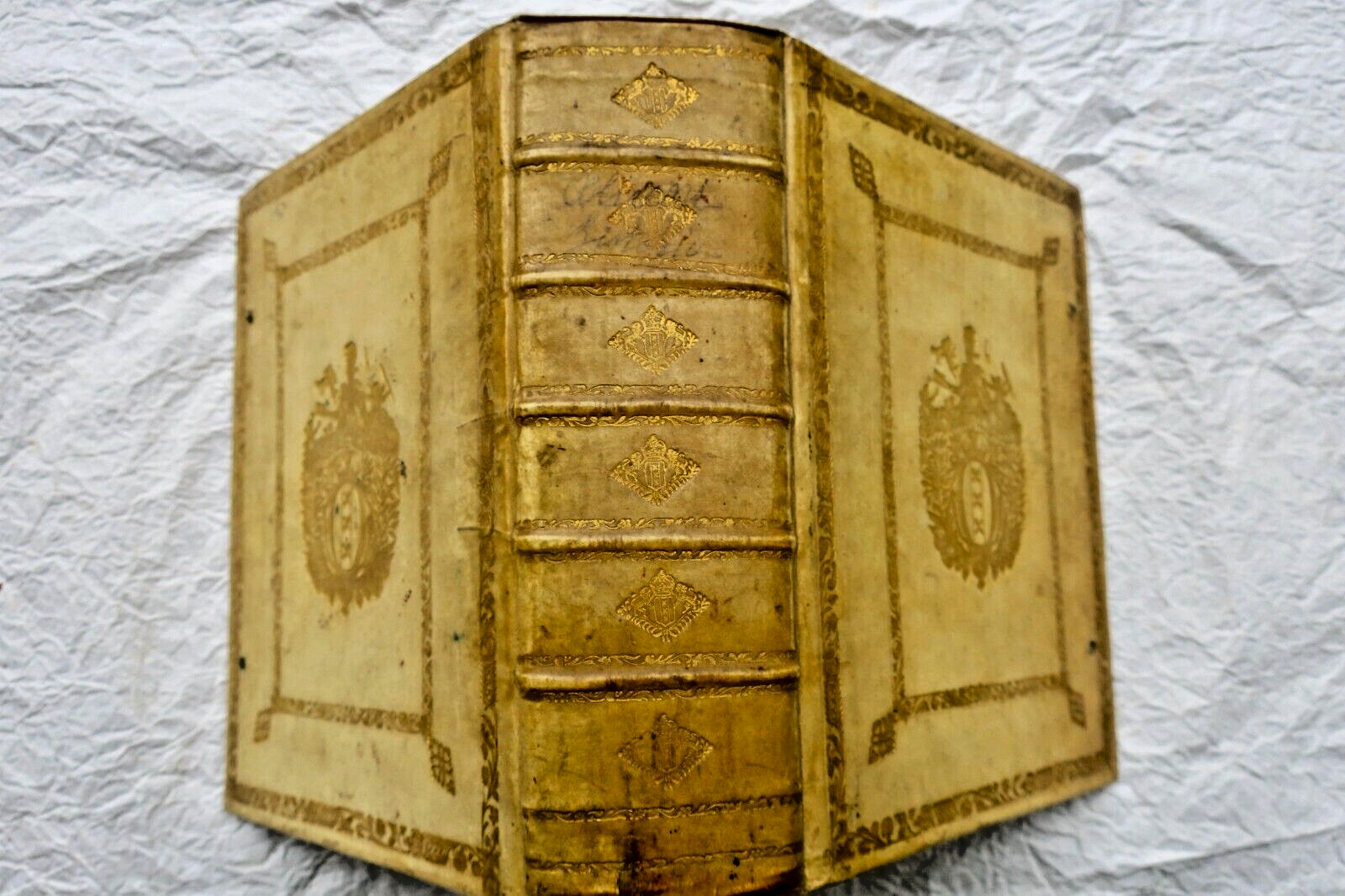
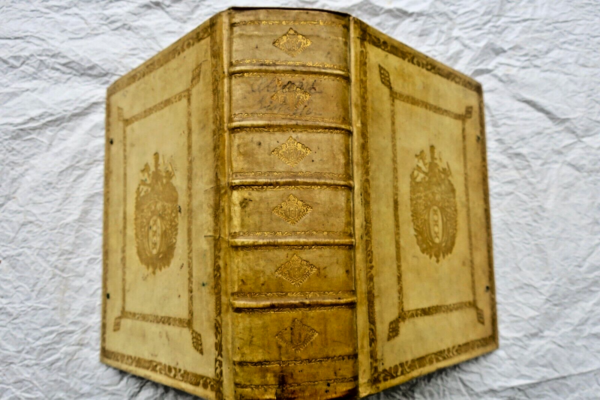 Reliure in full morocco with the arms of the Queen of Holland, 1731480€ View details ›
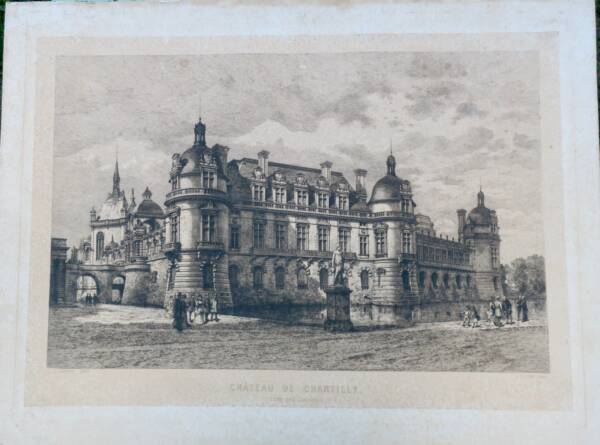 Chantilly landscape engraving by Sadoux, 1887480€ View details ›
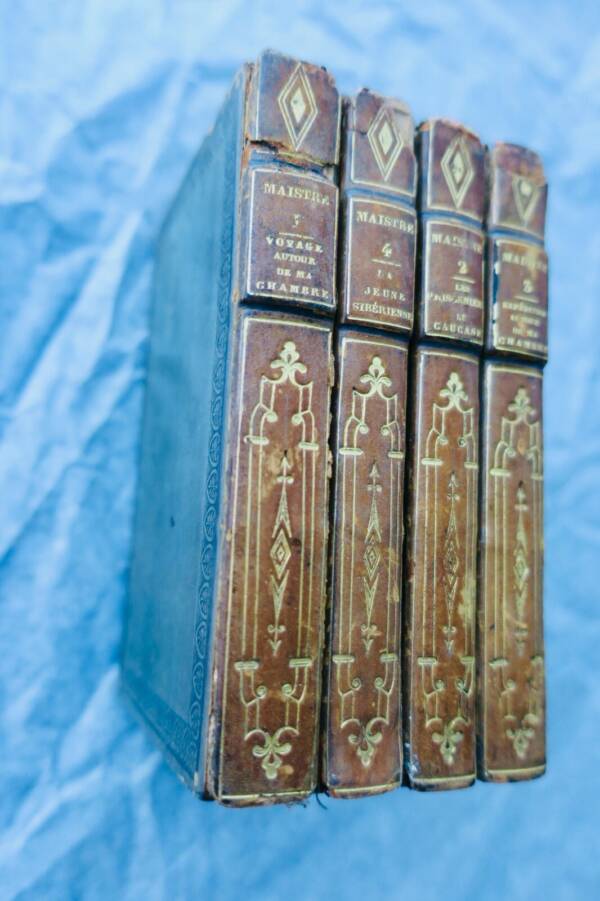 Xavier de Maistre’s introspective tales with Musset’s ex-libris360€ View details ›
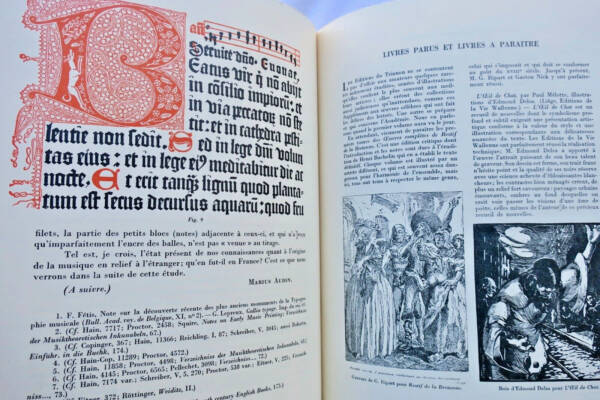 Artistic and documentary review of rare and modern books185€ View details ›
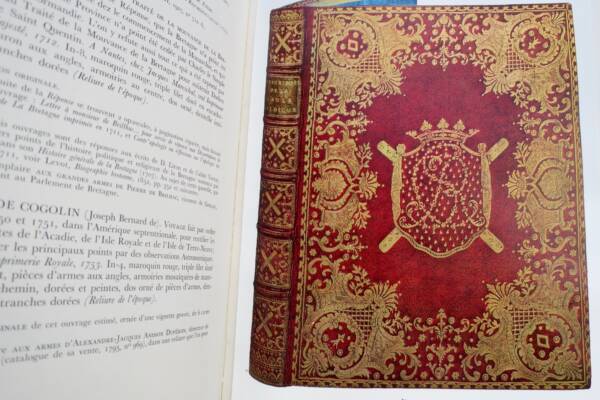 Collection of Rare Works181€ View details ›
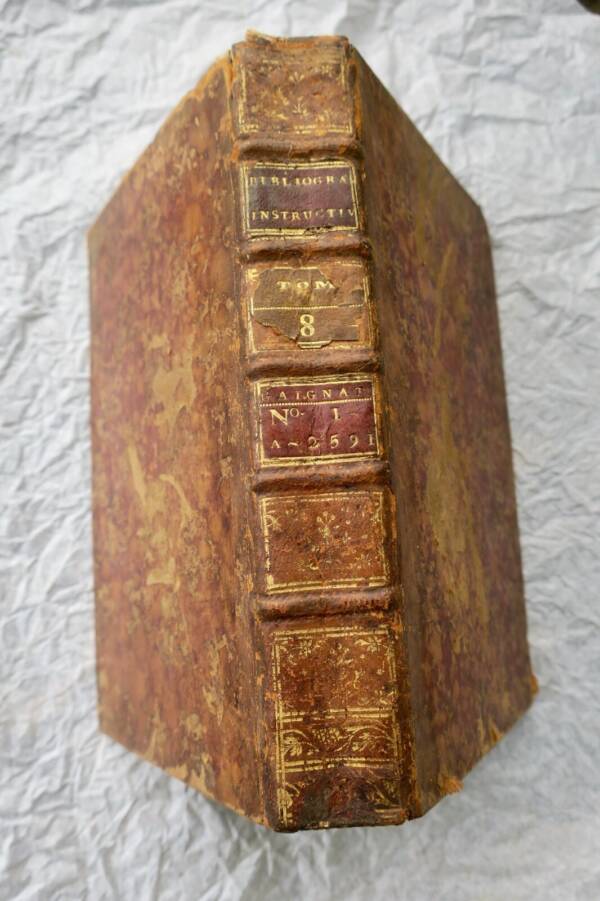 GAIGNAT SUPPLÉMENT À LA BIBLIOGRAPHIE INSTRUCTIVE, ou CATALOGUE DES LIVRES DU CAB172€ View details ›
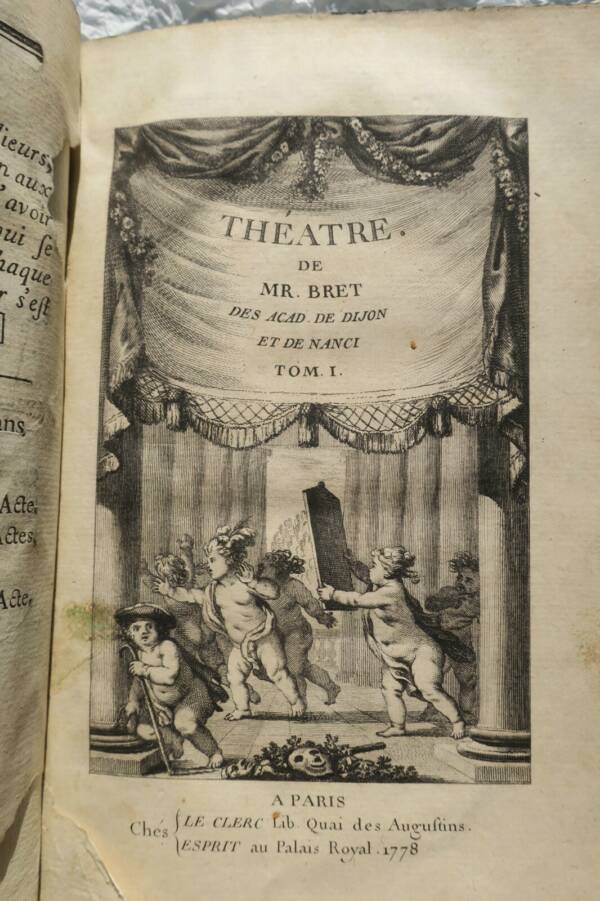 Theatre of Mr. Bret 1778172€ View details ›
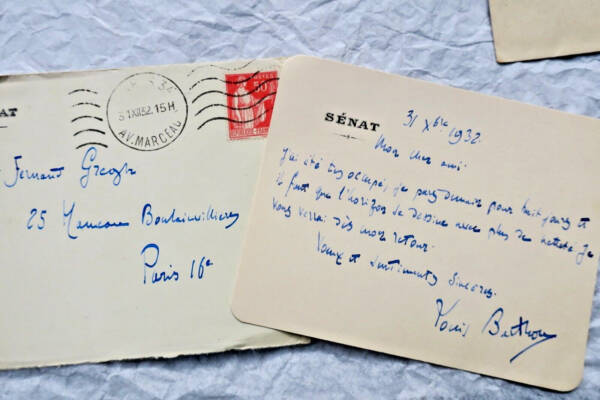 Louis Barthou’s 4 handwritten notes to poet Fernand Gregh160€ View details ›
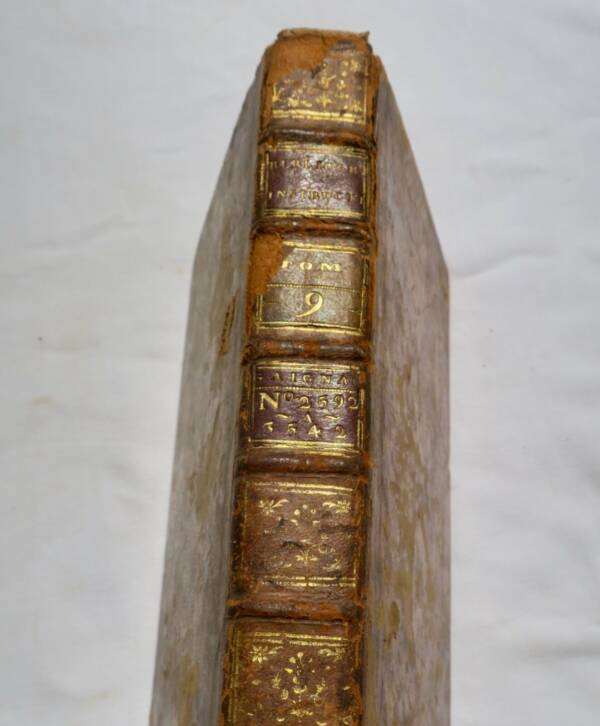 Catalog of Louis Jean Gaignat's Library Collection144€ View details ›
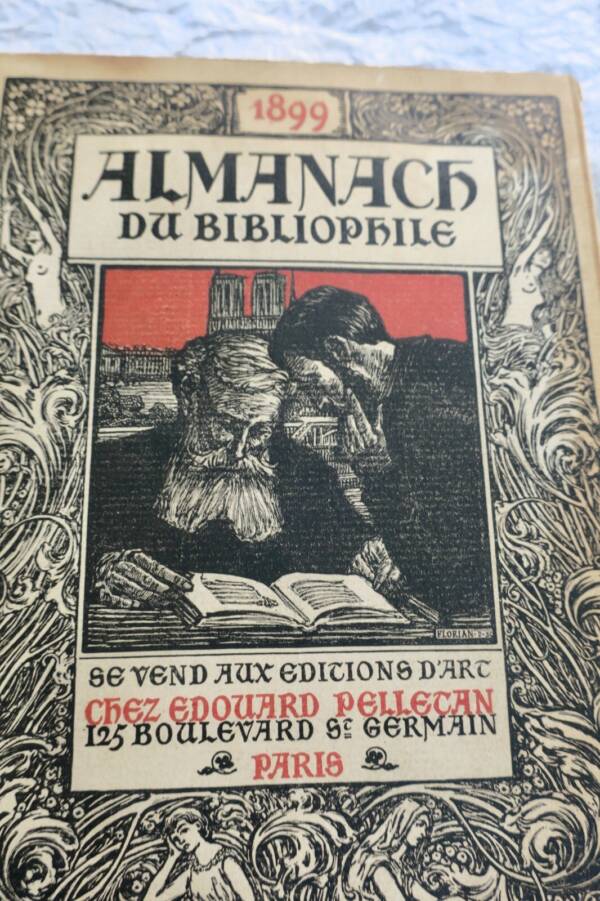 1899 Bibliophile’s Almanac144€ View details ›
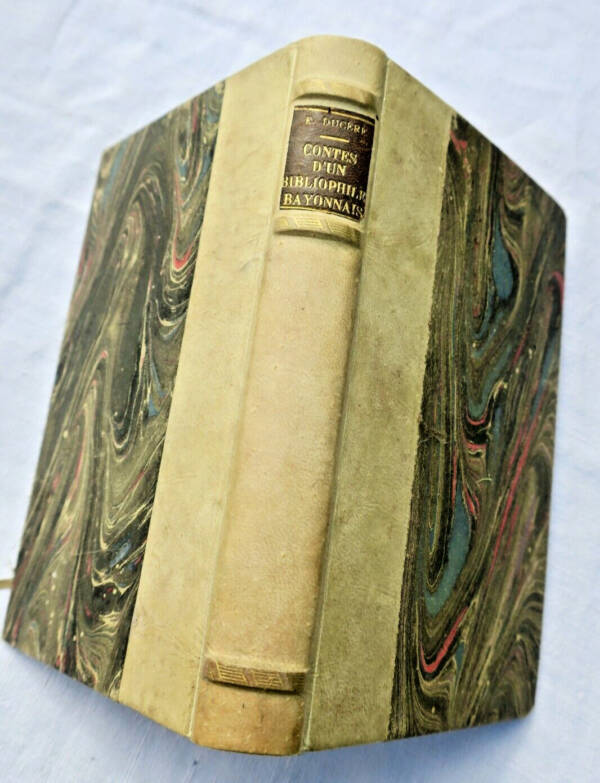 Tales from a Bayonne bibliophile's collection112€ View details ›
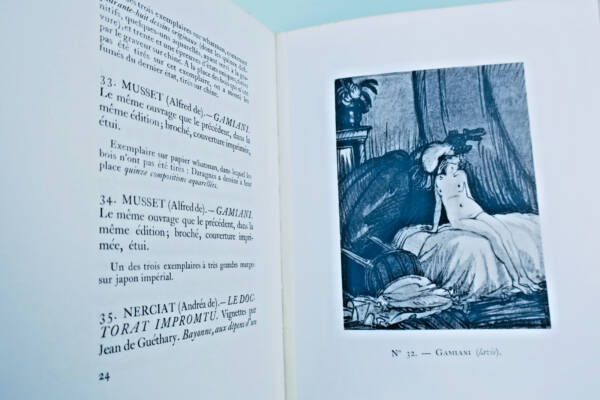 Catalogue of Daragnès’ Illustrated Books88€ View details ›
See all available books for “Barthou” ›
Look for ownership marks: arms stamped on the boards, ex-libris pasted to the pastedown, stamp, signature, or sale number in pencil. The arms can then be identified in the Olivier, Hermal and Roton directory, and the names in sale catalogues.
No. Arms have sometimes been added later to enhance a volume, or an armorial binding transferred to another book. The first check is to confirm that the book’s date, the binding style and the owner’s life align.
There is no fixed scale. Depending on the name, the quality of the copy and the strength of the evidence, the premium can range from a few tens of euros to many times the price of an ordinary copy; an undocumented provenance adds almost nothing.
Yes: the antiquarian book collection can be viewed as part of the Musée Condé’s tour at the Château de Chantilly. The most precious manuscripts are kept separately and only brought out for rare exhibitions; a reading room is available for researchers.
Yes, for two reasons: they are tools for tracking a copy, and they are collectable items when the sale is famous or the catalogue is illustrated. Depending on the sale, prices range from a few tens to a few hundred euros.
Tell us what is not working, we fix things quickly. The page you are on is attached automatically.