0
0€
An empty cart
You have no item in your shopping cart


Stendhal (1783–1842) did not achieve during his lifetime the success his novels enjoy today. His works, often published at the author’s expense or in limited print runs, circulated little. Collectors therefore seek first editions, annotated copies, or those from prestigious libraries. Each book in our care is examined page by page: paper condition, presence of plates, period binding, provenance marks.
A copy of Lucien Leuwen or Lamiel, for instance, gains in value if it retains its original wrappers or if it comes from a limited edition. The reprints of the 1920s–1930s, such as those from Le Divan that we offer, provide an accessible alternative to the originals, provided completeness is verified and clumsy restorations are absent. We sell only unique items, with transparent descriptions of their particularities.
Stendhal wrote for a select audience, the “happy few.” His novels, such as Le Rouge et le Noir or La Chartreuse de Parme, appeared in small print runs, sometimes under a pseudonym. The original editions, printed between 1830 and 1842, are rare and expensive. Collectors then turn to critical reissues, studies, or posthumous texts, such as Lucien Leuwen or Lamiel, published long after his death.
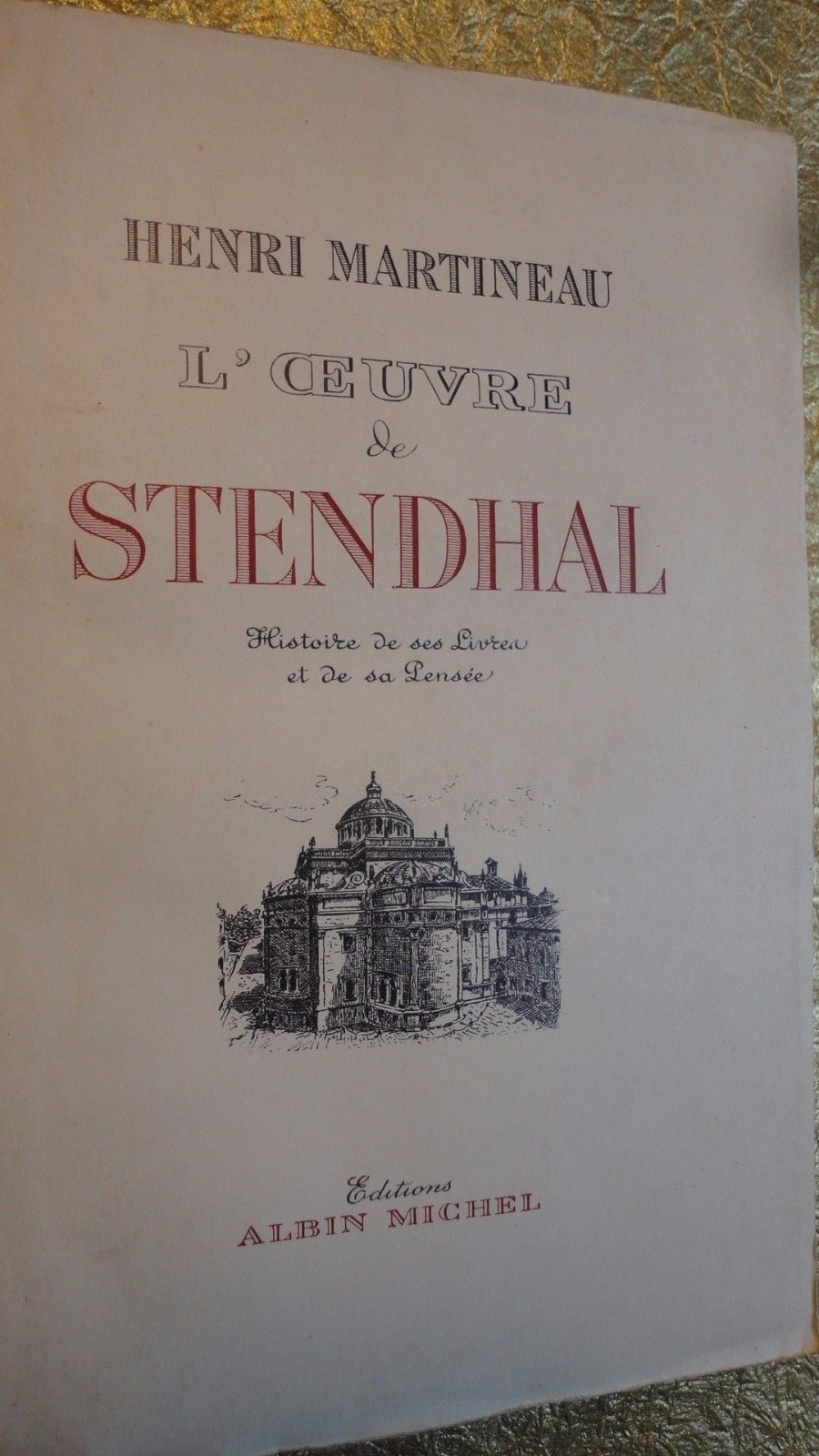
A copy of Romans et Nouvelles in the Le Divan edition (1926–1929), for example, stands out for its annotations by Henri Martineau. These volumes, often bound in half-morocco (demi-reliure), bear the mark of careful editorial work. Studies on Stendhal, such as Stendhal et l’Angleterre or Stendhal et les problèmes du roman, complete a collection by shedding light on his work and his era.
The first editions of Stendhal are recognizable by their typography, laid paper (papier vergé), and the absence of a publisher’s name on the title page. Le Rouge et le Noir (1830) and La Chartreuse de Parme (1839) are the most prized. Nineteenth-century reprints, such as those by Michel Lévy, often mimic the originals: check the date, the printer’s name, and the presence of errata corrected in later editions.
The Le Divan editions, published between 1926 and 1930, are sought after for their critical apparatus. A copy of Armance or Voyage dans le midi de la France must include all its plates and intact endpapers. Bindings in full calf (plein-cuir) or half-morocco (demi-maroquin), signed by workshops such as Creuzevault or Engel, enhance value. Beware of modern bindings, which can sometimes conceal flaws.
Late reprints, such as those from the 1950s, often reproduce texts without the care of the original editions. A 1950 Souvenirs d’égotisme, for example, may lack the preface or critical notes found in earlier editions. Incomplete copies, missing their plates or title pages, lose much of their value.
Modern bindings, even elegant ones, do not replace period bindings. Poorly executed restoration, using acidic glues or unsuitable papers, can damage the book in the long term. Provenance marks, such as ex-libris or manuscript annotations, must be authenticated: a library stamp or a famous signature increases value, but a false attribution destroys it.
An old book is judged by its paper, binding, and completeness. Wove paper, free of stains or foxing, is a good sign. Plates, if present, must be well printed, without misalignment or crease marks. The binding should be sturdy, with no loose stitching or damaged corners. Endpapers, often marbled, must be intact.
Common defects include missing pages, tears repaired with tape, or bindings that are too tight, preventing the book from opening properly. A copy of Stendhal et les problèmes du roman, for example, must include all its leaves, including the advertising pages at the end of the volume. We inspect each book before offering it, noting minor defects in the description.
We only offer books that have been individually checked. Each copy is described with precision: paper condition, binding, provenance marks, completeness. We indicate defects, even minor ones, so you know exactly what you are purchasing. Our books are unique, with features that make them collectible pieces.
Delivery is free, and you have 14 days to return a book if you are not satisfied. We answer your questions about authenticity, value, or the history of a copy. If you are looking for a specific edition, we can help you find it or estimate its value. Our Stendhal collection, such as the one currently in stock, covers rare texts and lesser-known studies, ideal for completing a collection.
The collection currently includes around 53 works where the name “Stendhal” appears: old editions, prestigious ones, period bindings, common copies, and rarer pieces. Each record is photographed and described by our team.
No copy available at the moment: come back soon, the stock changes every week.
The original editions of Le Rouge et le Noir or La Chartreuse de Parme fetch prices ranging from a few thousand to several tens of thousands of euros, depending on their condition and provenance. Reprints from the 1920s–1930s, such as those by Le Divan, are more affordable, though their value depends on completeness and binding.
A book is complete if it contains all its pages, including endpapers, title pages, and plates. Editions by Le Divan, for example, must include their notes and illustrations. We inspect each copy before offering it for sale.
Yes, a modern binding—even a high-quality one—cannot replace an original-period binding. It may conceal flaws or clumsy restorations. A half-calf binding from the 1920s, for instance, enhances a book’s value, whereas a skivertex binding from the 1980s diminishes it.
Yes, we can estimate a book’s value based on its edition, condition, and rarity. Send us detailed photos (title page, binding, flaws) and we will respond within 48 hours.
To explore further, browse our selection of works by other 19th-century authors: Victor Hugo, whose original editions and critical studies we offer, Alphonse Daudet for his Provençal tales, or Paul Valéry for his reflections on literature. Lovers of classics will also find Jean-Jacques Rousseau, Jean de La Fontaine, and Honoré de Balzac, with rare copies and illustrated editions.
Do you own books by Stendhal? We provide valuations and purchases.
Looking for a specific title?
Tell us what you are looking for: new books arrive every week and we will let you know as soon as a copy comes in.
Write to usDo you own books by Stendhal?
The bookseller appraises them free of charge and may offer to buy them.
Get an appraisalAlert me about new Stendhal arrivals
New books arrive every day. Leave your email address: you will receive a message as soon as a matching book enters the shop, never more than one a day.
Tell us what is not working, we fix things quickly. The page you are on is attached automatically.