0
0€
Your cart is empty
You have no items in your cart


Antique books on Egypt and the Orient form one of the great chapters of travel literature: accounts by merchants and diplomats, scholarly publications stemming from Bonaparte’s expedition, writers’ narratives, engraved albums and early photographic books. The Orient of ancient authors ranges from Egypt to Persia, via the Levant and Constantinople; this is the scope of this dossier, with the Far East remaining a separate category.
The first major witnesses are professional travellers. Jean-Baptiste Tavernier published in 1676 his Six Voyages to Turkey, Persia and India, Jean Chardin his Journal of a Journey to Persia ten years later: two key references for 17th-century Persia. The Levant has its scholarly accounts, such as Jean de La Roque’s Voyage to Syria and Mount Lebanon (1722), and Lady Mary Wortley Montagu describes Ottoman society from within in her letters from Constantinople, published in 1763.
By the end of the century, Egypt drew curious minds. Savary published his Letters on Egypt in 1785, Volney his Travels in Syria and Egypt in 1787, more restrained and critical in tone.
The Egyptian Expedition (1798–1801) brought over one hundred and sixty scholars, engineers and artists. Their work resulted in the Description de l’Égypte, issued in parts from 1809 to 1829: antiquities, modern state and natural history, with volumes of plates in exceptionally large format. A second edition, known as the Panckoucke edition, followed during the Restoration. Vivant Denon had anticipated the collective work with his Travels in Lower and Upper Egypt (1802), an immediate success.
Complete copies of the first edition are highly sought-after at auction. The Panckoucke edition is more commonly encountered, often as individual volumes or separate plates—each requiring close examination, as many have been trimmed, mounted or replaced by facsimiles. Campaign souvenirs also belong to our Napoleon and militaria section.
With Itinerary from Paris to Jerusalem (1811), Chateaubriand turned the journey to the Orient into a literary genre. Lamartine published his in 1835, Nerval compiled his Voyage en Orient in 1851 and Théophile Gautier issued Constantinople in 1853. Flaubert and Maxime Du Camp travelled through Egypt and the Near East from 1849 to 1851; Du Camp brought back Egypt, Nubia, Palestine and Syria (1852), one of the first French books illustrated with photographs.
Pierre Loti extends this vein into the 20th century, from Aziyadé (1879), a novel of Constantinople, to Vers Ispahan (1904) and La Mort de Philae (1909). In poetry, Les Orientales by Hugo (1829) shaped an entire imaginary; in tales, Les Mille et une nuits, translated by Antoine Galland from 1704 to 1717 and later by Mardrus from 1899 to 1904, inspired countless illustrated editions.
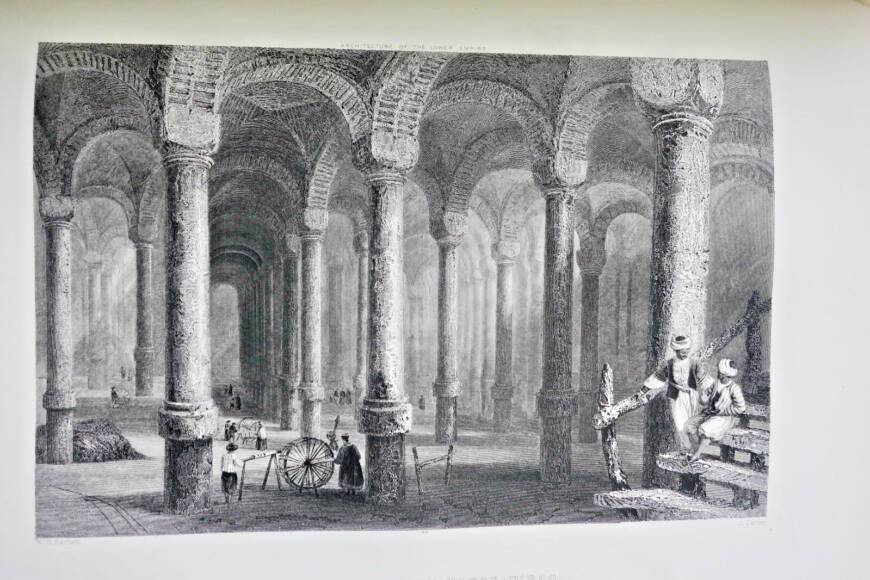
The term refers both to the scholarly study of the languages and civilisations of the Orient and to a 19th-century painting movement, from Decamps to Gérôme. Since Edward Said’s essay Orientalism (1978), these works are also read as reflections of a European gaze; their historical interest partly lies in this distance. Steel-engraved albums such as Julia Pardoe and William Bartlett’s The Beauties of the Bosphorus, collections of Ottoman costumes and photographs from Beirut, Cairo or Constantinople workshops are among the most sought-after examples.
For a travel narrative, first check for the presence of the announced maps and plates, often folding and therefore fragile. A first edition in its contemporary binding is worth more than a reprint, though some lavishly illustrated interwar reprints surpass the original. Steel-engraved albums, printed on sensitive papers, often suffer from foxing: a fresh copy commands a higher price.
Prices reflect rarity and condition. A Loti novel in a common edition can be found for a few dozen euros, an 18th-century travel narrative or a complete engraved album may reach several hundred euros. Provenance also matters: a copy annotated by a traveller or a diplomat gains documentary value.
Here are the items currently available on Egypt, the Levant, Constantinople and Persia, ranging from the most precious to the most affordable. The list updates automatically with each sale and new arrival.
The first, published from 1809 to 1829 by the Imprimerie impériale then royale, is the most prestigious and rarest. The Panckoucke edition, launched during the Restoration, presents the text in a more manageable format and is more commonly encountered.
Not necessarily: his books were printed in large numbers, and a common original can often be found for a few tens of euros. Large-paper copies, presentation copies, and illustrated editions command higher prices.
Period prints, often on albumen paper and mounted on card, frequently bear the name of the studio and a number within the image. A modern reproduction will have whiter paper and show a screen pattern under magnification.
Yes. The bookseller provides free estimates based on photographs of travel accounts, art books, and photographs of the Orient, and purchases entire libraries in Paris and throughout France.
Looking for a specific title?
Tell us what you are looking for: new books arrive every week and we will let you know as soon as a copy comes in.
Write to usDo you own antiquarian books?
The bookseller appraises them free of charge and may offer to buy them.
Get an appraisalAlert me about new Books on ancient Egypt and the Orient arrivals
New books arrive every day. Leave your email address: you will receive a message as soon as a matching book enters the shop, never more than one a day.
All our authors ›Our themed collections ›Our sections ›Full catalogue ›
Tell us what is not working, we fix things quickly. The page you are on is attached automatically.