0
0€
Your cart is empty
You have no items in your cart


The French antiquarian books on Asia form a very varied collection: accounts of embassies to Siam, letters from Jesuit missionaries in China, narratives of Mekong exploration, works on japonisme, language manuals and publications from French Indochina. They are read today as historical documents, viewed through the lens of their time. Here are the major collections, key editions to know and our available works.
Japan, China, Indochina, Siam and the Far East: our selection is updated with each new acquisition.
 Entretien d’un philosophe chrétien, et d’un philosophe chinois 1708 Malebranche1 900€ View details ›
 japon albums 818 argentic photographs950€ View details ›
 China RANDON (Marshal Count) BLONDEL (General) Account of the Expedition to China540€ View details ›
 China, the Third Giant: China305€ View details ›
 Adventure in China246€ View details ›
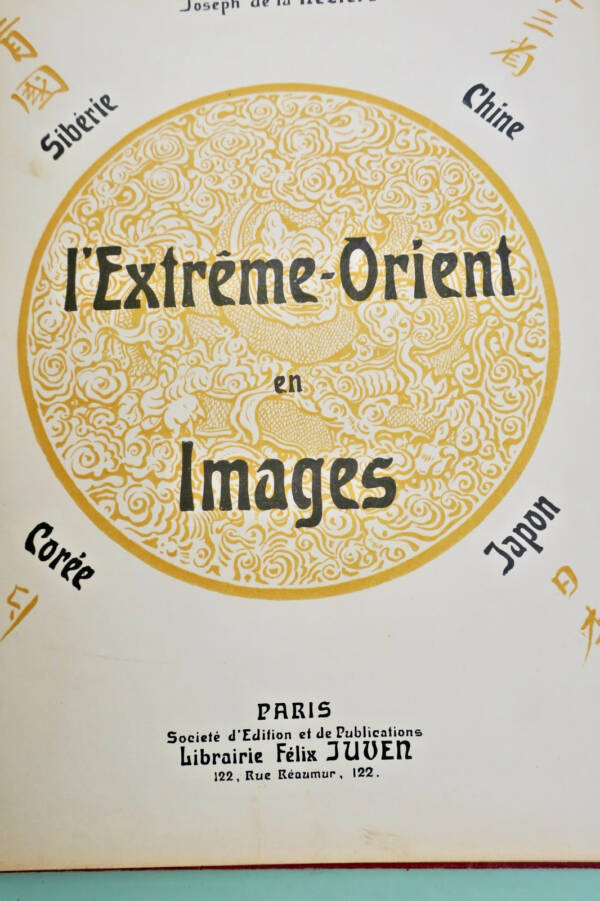 asie LA NEZIERE, Extrême-Orient en images220€ View details ›
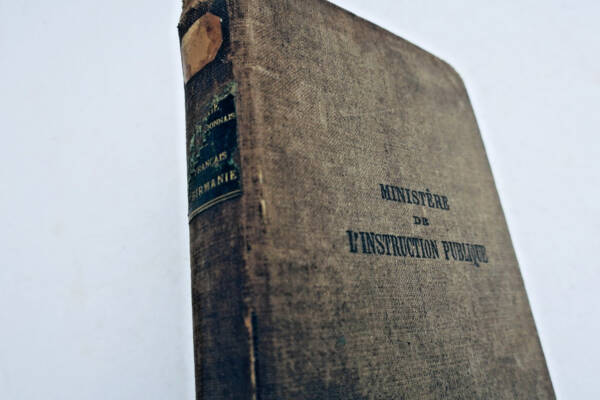 Comte A. Mahé de La Bourdonnais, Un français en Birmanie, 1891220€ View details ›
 Japanese Cinema by Tadao Sato210€ View details ›
 Sugiyama’s 1934 French Mission209€ View details ›
 Cheng: 1000 Years of Chinese Painting200€ View details ›
 Original Japanese silk painting 37 x 45 cm200€ View details ›
See all available books for “Asie” ›
Free delivery in mainland FranceSecure payment: card, PayPal, bank transfer, cheque14-day returns
Japan first became known to the Parisian public at the 1867 Exposition universelle, where it presented its national pavilion for the first time. In 1872, critic Philippe Burty coined the term ‘japonisme’. Siegfried Bing founded the journal Le Japon artistique in 1888, and Edmond de Goncourt published Outamaro (1891) and Hokousaï (1896), with the assistance of the dealer Hayashi Tadamasa, who had settled in Paris since the 1878 Exposition.
Literature followed. Pierre Loti drew Madame Chrysanthème (1887) from his stay in Nagasaki, later writing Japoneries d'automne (1889) and La Troisième Jeunesse de Madame Prune (1905); Judith Gautier published her Poèmes de la libellule in 1885, translated from Japanese and illustrated by Yamamoto Hōsui. The sale catalogues of Japanese art collections, such as that of Charles Gillot dispersed in 1904, complement this field closely followed by our Japanese clients. For them, these books hold a dual interest: they show Meiji-era Japan as seen by the French, and they preserve the record of the Japanese who collaborated on them, such as Hayashi Tadamasa or Yamamoto Hōsui.
China entered French libraries through missionaries. The Lettres édifiantes et curieuses, 34 volumes published from 1702 to 1776, and the Description de l'empire de la Chine by Father Du Halde (1735, four volumes adorned with maps and engravings), compiled in Paris from their correspondence, nourished the philosophers. Malebranche published as early as 1708 his Entretien d'un philosophe chrétien et d'un philosophe chinois.
In the 19th century came travellers such as the Lazarist Évariste Huc and his Souvenirs d'un voyage dans la Tartarie, le Thibet et la Chine (1850), followed by military accounts of the expeditions of 1860 and 1900, to be read as the viewpoint of a single side and compared with historians’ works. Loti published Les Derniers Jours de Pékin in 1902. For younger readers, Jules Verne released through Hetzel Les Tribulations d'un Chinois en Chine (1879), illustrated by Léon Benett, and Paul d'Ivoi his Cigale en Chine.
Siam fascinated the court of Louis XIV: the king sent the chevalier de Chaumont there in 1685, accompanied by the abbé de Choisy, and received the embassy of Kosa Pan at Versailles on 1 September 1686. Simon de La Loubère, sent in 1687, produced Du royaume de Siam (1691, two volumes), still cited by historians.
Two centuries later, Henri Mouhot introduced Angkor to European readers in Le Tour du monde (1863). The Mekong mission led by Doudart de Lagrée and then Francis Garnier, from 1866 to 1868, resulted in Voyage d'exploration en Indo-Chine, published by Hachette in 1873 with two volumes of atlas. This was followed by the Bulletin de l'École française d'Extrême-Orient, whose first volume appeared in 1901, Un pèlerin d'Angkor by Loti (1912), Annamite language manuals, brochures from the 1931 Colonial Exhibition and accounts of the Indochina War.
Yes. Works on Japonisme, Loti’s travelogues, early translations of Japanese poetry and catalogues of Parisian collections of Japanese art have many enthusiasts in Japan. We ship worldwide, including Japan, with tracking.
It refers to a printing on Japanese paper, a luxury paper with long fibres often used for deluxe copies of French editions. The book may be about any subject, not necessarily Japan.
Like period documents: they provide information about the countries described, but also about the prejudices and interests of their authors. Historians cross-reference them with local sources, and collectors can do the same.
Most range from a few dozen to a few hundred euros. A complete original edition with its plates and maps, in period binding and in good condition, can fetch a higher price; an estimate based on photographs can help assess yours.
Looking for a specific title?
Tell us what you are looking for: new books arrive every week and we will let you know as soon as a copy comes in.
Write to usDo you own antiquarian books?
The bookseller appraises them free of charge and may offer to buy them.
Get an appraisalAlert me about new The Asian Presence in Early Printed Books arrivals
New books arrive every day. Leave your email address: you will receive a message as soon as a matching book enters the shop, never more than one a day.
All our authors ›Our themed collections ›Our sections ›Full catalogue ›
Tell us what is not working, we fix things quickly. The page you are on is attached automatically.