0
0€
Your cart is empty
You have no items in your cart


A rare book on botany or gardening is first judged by its plates and condition. Floras serve to name plants, herbals to preserve them, and treatises to cultivate a kitchen garden or design a park. Here are the bookseller’s guidelines for making a good purchase, followed by our available works, updated with each new arrival.
Below are the botanical and gardening books currently available, from the most valuable to the most affordable. The list updates automatically with every sale and new arrival.
 Garden and houseplant atlas720€ View details ›
 Plants, flowers, foliage, fruits, and vegetables in nature266€ View details ›
 Birds, Flowers Small Natural History Gallery Miniature & Romantic Flowers225€ View details ›
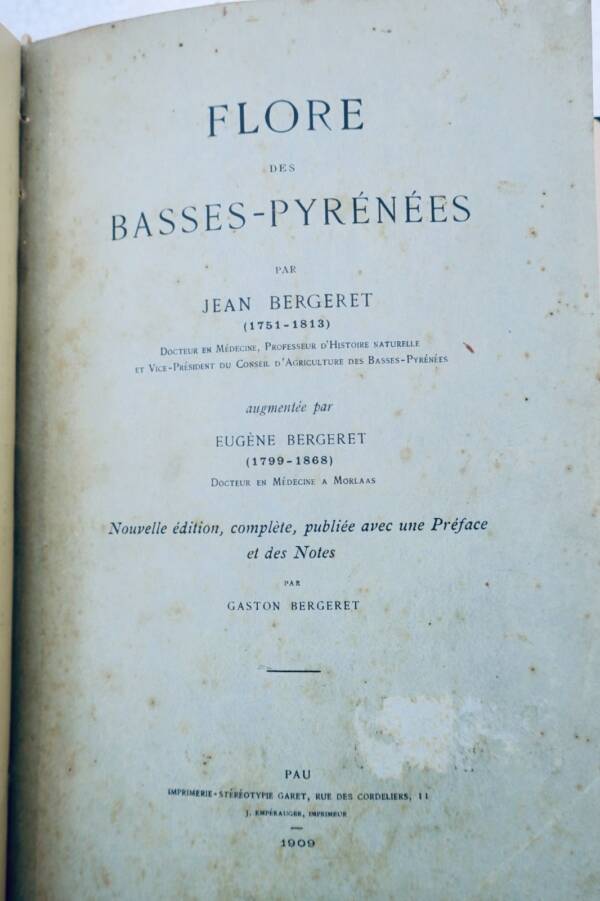 Pyrenees Jean Bergeret Flore des Basses-Pyrénées 1909220€ View details ›
 Horticultural Journal: April 1845–March 1846208€ View details ›
 Theory and Practice of Gardening205€ View details ›
 14 & 17 botanical plates with original drawings200€ View details ›
 Garden Decaisne Naudin Manual for Garden Lovers, Horticulture196€ View details ›
 Rural economy: comprehensive guide to countryside management148€ View details ›
 Condé-sur-Noireau’s history: public and private gardens145€ View details ›
 Jardin L'ECOLE DU JARDIN POTAGER 1752120€ View details ›
 1806 Almanac of Le Bon Jardinier120€ View details ›
See all available books for “botanique” ›
Free delivery in mainland FranceSecure payment: card, PayPal, bank transfer, cheque14-day returns
Modern botany arises from classification. Tournefort published his Éléments de botanique in 1694; Linnaeus’s Species plantarum (1753) established the two-word Latin names still in use today. The floras that followed are practical books: small format, dense text, identification keys, and a few plates at the end of the volume.
The word “herbarium” covers two objects. It can refer first to a collection of dried plants mounted on paper, often hand-labelled, which often appear in estates; it can also mean a book of engraved plates, such as Bulliard’s Herbier de la France, published at the end of the 18th century. A herbarium of dried plants is valued for the quality of its specimens and its labels, especially if the author can be identified.
Pierre-Joseph Redouté (1759–1840), favoured by Joséphine, gave the flower book its most celebrated form with Les Liliacées (1802–1816) and Les Roses (1817–1824). His plates are stipple engravings printed in colour and hand-finished with a brush. Complete copies command high prices at auction; single plates or modern reproductions are more common and must be distinguished from original period prints. Rousseau’s letters on botany were in fact reissued in 1805 with colour plates after Redouté.
Olivier de Serres devoted part of his Théâtre d’agriculture et mesnage des champs (1600) to gardens. La Quintinie, creator of the king’s kitchen garden at Versailles, left the Instruction pour les jardins fruitiers et potagers, published in 1690 after his death, while Dezallier d’Argenville codified the French formal garden in La Théorie et la pratique du jardinage (1709).
The 18th century saw a proliferation of manuals, such as Combles’s L’École du jardin potager, after which taste turned to the landscape park celebrated by Delille in Les Jardins (1782). In the 19th century, the Revue horticole, Decaisne and Naudin’s Manuel de l’amateur des jardins, and nursery catalogues accompanied the vogue for greenhouses and exotic plants.
Founded in 1755, the Bon Jardinier almanac was reissued almost every year, bearing the name Vilmorin on the title-page from 1819 to the late 19th century. Its successive volumes allow one to trace the arrival of new varieties. It makes a good first purchase, comparable to our old almanacs.
Under the Restoration, the flower becomes a message. Le Langage des fleurs by Charlotte de La Tour, published around 1819 and often reprinted by Garnier, assigns a meaning to each species and sparks a host of small-format imitations.
In 1847, Grandville’s Les Fleurs animées, with texts by Taxile Delord, transforms each flower into a character. It is a classic of Romantic illustrated books, to be checked plate by plate.
Learn to recognise the process. Hand-coloured engravings feature watercolour washes, sometimes overflowing; chromolithography, common after 1850, offers smooth colour fields and a fine grain visible under a loupe; stencilled colouring from the 1920s yields bold, matte hues. Flower books were often disbound for framing: count the plates before purchasing.
Condition dictates price. A worn flora that remains complete is still a useful reference; a trimmed, soiled or sun-bleached plate loses most of its value. Foxing, common on 19th-century papers, is acceptable if it spares the colours.
Store these volumes in a dry room, away from direct light that fades watercolours. A dried-plant herbarium requires monitoring: leaf through it occasionally, as booklice and silverfish are drawn to it. As for pricing, expect anything from a few tens of euros for a common flora to several hundred for an 18th-century treatise in fine binding or a complete coloured atlas.
A flora is a book that describes and identifies the plants of a region. An herbarium is a collection of dried plants; the term also refers to certain sets of printed plates.
Examine the paper and, for an engraving, the plate mark left by the copper plate. Under a loupe, a modern reproduction will show a regular dot screen, absent from hand-coloured engravings and old chromolithographs.
### Does a Bon Jardinier almanac have value?A modest but real value: a few dozen euros for a common 19th-century edition, more for an 18th-century edition or a well-bound copy. Condition matters more than the year.### Do you buy libraries on gardening and botany?Yes. The bookseller offers free estimates based on photos for books on botany, gardening and horticulture, and purchases entire libraries in Paris and throughout France.## To go further- [Estimate old natural science books](/estimation-livres-sciences-naturelles-xviii-xix/) - [Old almanacs and directories](/livres-anciens/almanachs-et-annuaires/) - [Romantic illustrated books (1830–1860)](/curmer-hetzel-magnin-livres-illustres-romantiques/) - [Preserving an old book](/conservation-livre-ancien-humidite-lumiere/) - Sections [Lifestyle](/rayon/art-de-vivre/) and [Science, technology and law](/rayon/sciences-techniques-et-droit/) - [Have your old books appraised](/vendre-estimer-vos-livres/) - [Old prints and engravings: how to recognise, choose and preserve them](/livres-anciens/gravures-et-estampes/)Looking for a specific title?
Tell us what you are looking for: new books arrive every week and we will let you know as soon as a copy comes in.
Write to usDo you own antiquarian books?
The bookseller appraises them free of charge and may offer to buy them.
Get an appraisalAlert me about new Botanical and Garden Antiquarian Books arrivals
New books arrive every day. Leave your email address: you will receive a message as soon as a matching book enters the shop, never more than one a day.
All our authors ›Our themed collections ›Our sections ›Full catalogue ›
Tell us what is not working, we fix things quickly. The page you are on is attached automatically.