0
0€
Your cart is empty
You have no items in your cart


Theatre is collected in two ways: through texts, from major editions of Molière, Corneille and Racine to the originals of modern playwrights, and through stage memory, with programmes, posters, reviews and costume designs. Here are the bookseller’s guidelines for choosing and the vocabulary pitfalls to avoid, followed by our available works, updated with each new arrival.
Below are the theatre-related items currently available, from the most valuable to the most affordable: editions of classics, original plays, programmes, and stage documents. The list updates automatically with each sale and new acquisition.
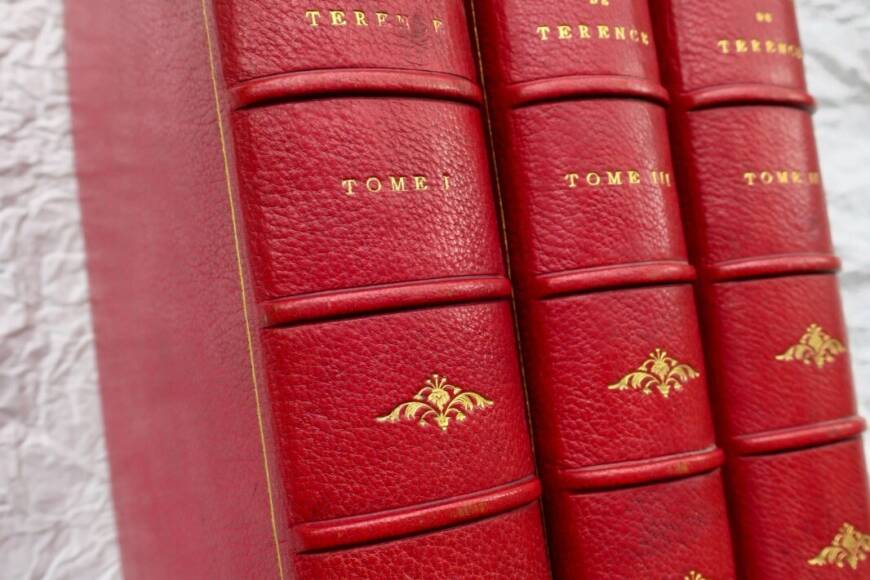
 Comedies by Terence Les Comédies de Térence 1771 full-leather binding760€ View details ›
 Alzire ou les Américains… theatre poster 1798 IV Prairial Year VI660€ View details ›
 Alzire or the Americans - Theatre Poster 1798660€ View details ›
 Cocteau's Pigalle Theatre Highlights650€ View details ›
 Molière’s Complete Works in 8 Volumes, 1710 Edition620€ View details ›
 Shakespeare — The Plays of Shakespeare illustrated by Selous480€ View details ›
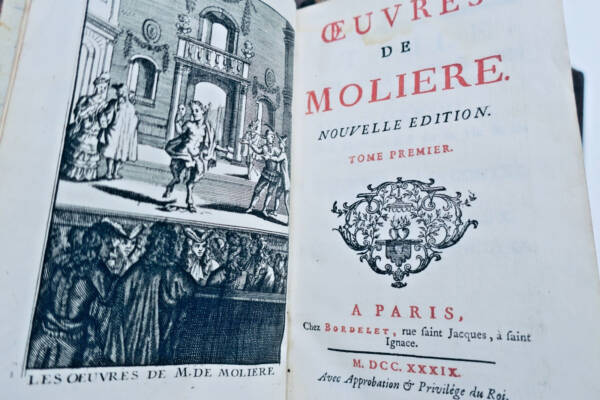 Molière Works of Molière 1739 Bordelet250€ View details ›
 Debureau History of the Four-Sous Theater, to continue the history 1833218€ View details ›
 Racine’s works with Geoffroy’s 1808 commentary218€ View details ›
 Theatre of Mr. Bret 1778215€ View details ›
 Complete Works of Racine210€ View details ›
 Molière's Troupe and the Corneille Brothers in Rouen 1658202€ View details ›
See all available books for “théâtre” ›
Free delivery in mainland FranceSecure payment: card, PayPal, bank transfer, cheque14-day returns
For Molière, who died in 1673, the first complete edition of his works, prepared by La Grange and Vivot, was published in 1682; it is beyond the reach of most collectors. The 1734 in-quarto edition, illustrated after Boucher, remains the great 18th-century edition, and its engravings also circulated separately. Romantic editions, such as the one adorned with vignettes by Tony Johannot, offer a more accessible entry point.
Corneille is sought after in the edition annotated by Voltaire (Geneva, 1764), adorned with figures by Gravelot. Racine has his typographic monument with the in-folio edition by Pierre Didot (1801–1805), and his 19th-century annotated editions remain fine reading copies. For ancient theatre, 18th-century translations yield handsome copies, such as the Comédies of Terence translated by the abbé Le Monnier (1771).
Complete works, often in several volumes, must be checked volume by volume and plate by plate. Individual plays, issued as slim pamphlets at the time of their premières, are the original editions of the repertoire. Their title pages often indicate the theatre and the date of the first performance, a detail invaluable for dating a copy.
The preface to Cromwell (1827) served as a manifesto, Henri III et sa cour by Alexandre Dumas triumphed in 1829 and the première of Hernani, on 25 February 1830 at the Théâtre-Français, remains the most famous battle in French theatrical history. The originals by Hugo, Dumas or Vigny (Chatterton, 1835) appear as pamphlets or contemporary half-bindings; the freshness of the paper and the presence of wrappers make all the difference in price.
Musset occupies a special place. After the failure of La Nuit vénitienne at the Odéon in December 1830, he wrote for the page, hence the title Un spectacle dans un fauteuil, and his comedies only took hold on the Paris stage from 1847, with Un caprice. His illustrated Comédies et proverbes, from the late 19th century to the 1920s, rank among the most pleasant theatre books to assemble.
Theatre documents reveal what texts conceal: who performed, in what setting, before which audience. A poster from the revolutionary era, dated according to the Republican calendar, a programme from the Ballets Russes or the Comédie-Française, a signed photograph of an actor—these all form a distinct collection, often more affordable than major books.
Magazines bring the image to life: Comœdia, the daily founded in 1907, its supplement Comœdia illustré, and the theatrical supplements of L’Illustration. Nineteenth-century engraved and hand-coloured costume designs preserve traces of vanished productions, while original costume or set models, in watercolour or gouache, rank among the most sought-after items.
A author’s presentation copy often greatly enhances a modern play. Twentieth-century playwrights frequently inscribed their press copies: an inscription to an actor, director, or influential critic carries far more weight than a generic note to an unknown recipient. Check the handwriting and legibility of the recipient’s name.
The word “théâtre” long denoted “comprehensive chart” or “atlas.” The Théâtre françois published in Tours in 1594 by Maurice Bouguereau is an atlas, while Olivier de Serres’s Théâtre d’agriculture (1600) is an agronomy treatise. “Comédie” offers similar surprises with Balzac’s Comédie humaine or Dante’s Divine Comedy: these titles have been excluded from the selection below.
Often just a few dozen euros for a common item. A first edition by a major author with its original wrappers, or bearing an inscription, can be worth considerably more; the condition of the paper, often fragile in such pamphlets, is a major factor.
Look on the title-page for a mention of the first performance, compare it with the printing date, and consult a standard bibliography, such as Vicaire for the 19th century. A mention of “new edition” indicates a later impression.
Yes, especially those from famous premières, the Ballets Russes or major Parisian stages, and those illustrated by well-known artists. A complete programme, without trimming or missing pages, is significantly more valuable.
Yes. The bookseller will provide a free estimate from photographs of books and theatre-related documents, and purchases entire libraries in Paris and throughout France.
Looking for a specific title?
Tell us what you are looking for: new books arrive every week and we will let you know as soon as a copy comes in.
Write to usDo you own antiquarian books?
The bookseller appraises them free of charge and may offer to buy them.
Get an appraisalAlert me about new Theatre in Early Printed Books arrivals
New books arrive every day. Leave your email address: you will receive a message as soon as a matching book enters the shop, never more than one a day.
All our authors ›Our themed collections ›Our sections ›Full catalogue ›
Tell us what is not working, we fix things quickly. The page you are on is attached automatically.