0
0€
Your cart is empty
You have no items in your cart


A Victor Hugo first edition represents, for the discerning bibliophile, the gold standard of 19th-century French literature. For three decades, La Librairie Antique has scoured auction rooms and discreet estates, handling hundreds of copies—from the most modest to the most sumptuous. The market for Victor Hugo first editions today ranges from €200 for a common volume in fair condition to over €100,000 for exceptional pieces. A Japan-paper copy of Les Misérables even fetched nearly €85,000 at a Drouot sale in 2023, underscoring the enduring strength of a market built on 150 years of unbroken demand.
This guide, distilled from expertise gathered among French, Japanese, American, and German bibliophiles, will equip you to identify a true Victor Hugo first edition, understand why two identical copies can command price gaps of 1 to 50, and target the most relevant works within your budget. You’ll find the chronology of thirty essential first editions, arranged by decade, with realistic price ranges as of 2026, the classic pitfalls (Gosselin reprints of 1832 mistaken for the 1831 first edition, Belgian forgeries of Les Châtiments), and an overview of the international market that now shapes the novelist’s standing.
The 19th century produced giants, yet none matches Hugo in the consistency of his market value. Three reasons explain this.
First, an enormous editorial output. Sixty years of writing, thirty major works issued as Victor Hugo first editions, not counting reprints, illustrated editions, and posthumous publications. An inexhaustible trove for collectors, who can build a coherent library over ten or twenty years without ever exhausting it.
Second, a political and historical dimension that transcends literature. Les Châtiments (1853), clandestinely printed in Brussels during exile, or Quatrevingt-treize (1874), written after the Commune, are direct witnesses to their era. American and British collectors, drawn to French history, prize them highly. The German market, traditionally loyal to Renduel and Gosselin editions from the Romantic decade, remains a steady buyer.
Finally, immediate international recognition. As early as 1831, Notre-Dame de Paris was translated into English under the title The Hunchback of Notre-Dame; Les Misérables, published in 1862, became a global phenomenon, translated into fifteen languages within its first year. Today, the Japanese market eagerly seeks illustrated Hetzel editions, while Russia rediscovers Hugo after the collapse of the USSR—even Tolstoy considered him a master. The complete bibliography of Victor Hugo on Wikipedia provides an overview of the scale of this output.
In 2022, we appraised for a Parisian estate a set of twelve volumes including Les Contemplations (1856) and La Légende des Siècles (1859), both in Victor Hugo’s original editions. Their combined value: €4,800 in fair condition, but nearly €12,000 for pristine copies with their original bindings intact. Proof that in Hugo bibliophilia, condition often outweighs sheer rarity.
Collecting Hugo requires mastering six decades of literary creation. Below are the milestones to know, grouped by period.
This was the period when the young Hugo, still a monarchist, forged his style. Victor Hugo original editions from this time are rare and often overlooked by casual collectors. Odes et Poésies diverses (1822, Pélicier) was his first published book, at the age of twenty. Only fifty copies were printed. Expect €3,000 to €6,000 for a complete copy. Han d’Islande (1823, Persan), a four-volume Gothic novel in-12°, sells for between €1,800 and €2,500 in original wrappers, and €800 to €1,200 in 19th-century binding. Cromwell (1828, Ambroise Dupont) carries the famous Preface, a manifesto of Romanticism: €400 to €700 in wrappers, €200 to €350 in binding.
These early editions are often neglected in favour of his major novels. Yet their rarity makes them sound investments, particularly for German collectors who especially prize Renduel and Gosselin editions from this decade.
This is Hugo’s golden age, when every publication was an event. First editions from this decade are among the most sought-after. Marion de Lorme (1831, Renduel), a play banned by censorship then authorised after July 1830, is valued at €300–600 in good condition for a first edition in sound state. Notre-Dame de Paris (1831, Gosselin) remains the holy grail: two volumes in-8° with Tony Johannot’s frontispiece. A complete paperback sells for €4,000–8,000, but a copy with an autograph dedication or original drawings can exceed €15,000. See our detailed entry for the Gosselin 1831 edition of Notre-Dame de Paris.
Lucrèce Borgia (1833, Renduel) in first edition: €500–900. Les Voix intérieures (1837, Renduel), a major poetry collection: €400–800. Les Rayons et les Ombres (1840, Delloye): €350–700.
In 1830 the Hernani battle pitched classicists against the Romantics. Copies of the play published by Mame in 1830 are now extremely rare. We examined one in 2019, estimated at €2,200 for a complete paperback in fair condition.
The exile in Jersey then Guernsey gave birth to masterpieces. First editions from this period were often printed in Brussels or Switzerland to evade imperial censorship. Les Châtiments (1853) were smuggled out in Brussels by Henri Samuel. A complete original edition sells for €1,500–3,000. Beware of expurgated issues (Geneva–New York, 1853), which are less sought-after (€500–800). Les Contemplations (1856, Pagnerre/Lévy/Hetzel), two volumes with Célestin Nanteuil’s frontispiece: €1,200–2,500 in good condition. La Légende des Siècles (1859, Hetzel), first series in two volumes: €800–1,800.
Les Misérables (1862, Pagnerre & Lacroix) is the most collected edition: ten volumes in-8° with the famous illustrated yellow wrappers. A fine complete copy of this first edition sells for €3,000–8,000. The 25 copies on Japanese paper, printed for subscribers, command top prices: €25,000–80,000 depending on condition. Today the first edition of Les Misérables is more sought-after in Tokyo than in Paris for large-paper copies. For heirs uncertain of the next step, our guide to valuing inherited rare books sets out the procedure before any sale.
A first-hand account. In 2021, a client brought us a collection inherited from her grandfather, including a 1862 Misérables in apparently poor condition. After thorough examination, we identified a separate issue copy on vellum paper, unrecorded in standard bibliographies. Its sale fetched €18,000 for the client, who had initially thought she had received “an old damaged book.”
Following the fall of Napoleon III, Hugo returned to France. His final works, darker in tone, are now highly sought after. Les Travailleurs de la Mer (Victor Hugo, first edition, 1866, Lacroix): €800–1,500. L’Homme qui rit (1869, Lacroix), a Gothic novel: €1,500–3,000. American collectors particularly prize this title. Quatrevingt-treize (1874, Michel Lévy): €600–1,200, up to €2,000 in fine condition. L’Art d’être grand-père (1877, Hetzel): €300–600. La Fin de Satan (1886, posthumous): €200–400.
Hetzel-Quantin editions—i.e., the complete illustrated works published from 1853 to 1894—are especially prized in Japan. A complete set in quarto can fetch between €1,500 and €3,500 depending on the condition of the percaline bindings.
Books for sale on this subject
Not all first editions of Victor Hugo are equal, and some misleading reprints still circulate on the market. Below are the criteria we apply consistently.
First, original binding. A true first edition of Victor Hugo must retain its original glazed paper covers, its glued spine, and sometimes its original publisher’s advertisements on the verso. Any copy sold without its original wrappers automatically loses its status as a “complete” first edition in the strict bibliophilic sense. Copies rebound in the 19th century lose 30–50% of their value, unless the binding is by a master binder (Trautz-Bauzonnet, Chambolle-Duru, Marius Michel). Example: a 1831 Notre-Dame de Paris in original wrappers is worth €6,000; the same copy rebound in half-morocco in the 20th century will not exceed €2,500.
Secondly, large-paper copies and special print runs. Hugo often supervised large-paper editions (Japan, Holland, China, Whatman). These copies, numbered or not, are worth five to ten times more than standard print runs. Les Misérables 1862: 25 copies on Japan paper (€25,000–80,000), 500 on Holland paper (€3,000–6,000). Les Contemplations 1856: 100 copies on Whatman paper (€2,000–4,000). Caution: forged large-paper copies exist. Always check the watermark by transparency and the mention of the justification of the print run at the end of the volume.
Thirdly, pirate editions and counterfeits. In the 19th century, Belgian and Swiss counterfeits flooded the French market, and their price gap with a genuine first Victor Hugo edition can reach 80%. A genuine Victor Hugo first edition must bear the address of the French publisher (Gosselin, Renduel, Hetzel, Lacroix, Pagnerre, Michel Lévy). Common case: Les Châtiments 1853, whose first edition is Belgian (Henri Samuel in Brussels), while the Geneva counterfeits of the same year are less valued.
Fourthly, presentation copies. A copy with a Hugo autograph dedication is worth three to ten times more. In 2020, we handled a Voix intérieures 1837 with a dedication to Juliette Drouet for €3,800 (compared to €600 for a copy without dedication). To verify the authenticity of a signature, compare it with certified autographs available on Gallica BnF, which offers manuscript facsimiles.
The Hugo Notre-Dame de Paris first edition (Gosselin, 1831) remains the most iconic Victor Hugo first edition, and the one whose variants cause the most attribution errors. Here is what you need to know to avoid mistakes.
Characteristics of the 1831 Notre-Dame de Paris first edition: two volumes in-8° (13 x 21 cm) in original wrappers; yellow covers with black titles, smooth spines; engraved frontispiece by Tony Johannot; half-title reading “Notre-Dame de Paris” with the subtitle “1482”; first print run of 1,500 copies for the first state, 3,000 for the second with typographical corrections.
Common pitfall: Gosselin reprints from 1832 and 1833 are regularly mistaken for the first edition, sometimes in good faith. Always check the date on the title page and on the colophon. Variants and their 2026 values: first printing 1831 with the error “Quasimoda” on page 11, €6,000–10,000 in wrappers, up to €15,000 for an enhanced copy; second printing 1831 with corrected spelling, €4,000–8,000; illustrated edition 1832 with five plates, €2,500–5,000.
International market: Anglo-Saxon collectors pay 20 to 30% more for a first edition of Hugo’s Notre-Dame de Paris in perfect condition. In 2023, a copy of the first impression sold for €12,500 at Christie’s London, following bids mainly from American and Japanese buyers. The value of old Hugo editions for this specific title remains one of the most closely watched indicators in the market.
Victor Hugo’s Les Misérables first edition of 1862 is a textbook case in bibliophilia. Here’s why two seemingly similar copies can command such vastly different prices, with a ratio of 1 to 400.
First criterion: printing and paper. Standard printing on ordinary paper, 5,000 copies: €3,000 to €8,000 for a fine complete copy. Large-paper Holland edition, 500 copies: €3,000 to €6,000. Japan paper edition, only 25 copies: €25,000 to €80,000. In 2022, we appraised two copies of Hugo’s Les Misérables first edition in the same week. A standard printing in poor condition (losses, significant foxing, missing covers): €200. A Japan paper copy, complete with its original yellow covers intact: €78,000, sold to a Japanese collector.
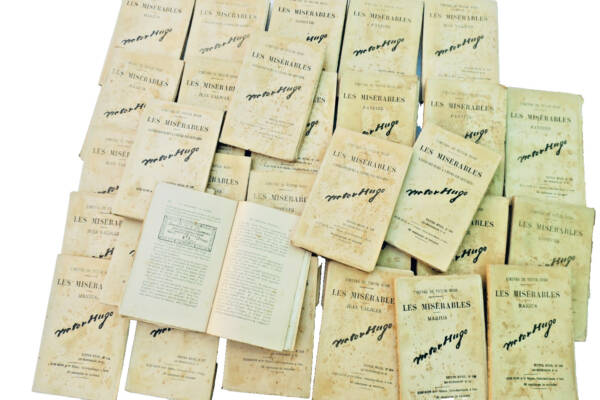
Second criterion: completeness. Les Misérables first editions comprise ten volumes divided into three parts (Fantine parts I-II, Cosette parts III-IV, Marius parts V-VI, Saint-Denis parts VII-VIII, Jean Valjean parts IX-X). An incomplete set loses 50 to 70% of its value. Beware of lots described as “almost complete”: missing volumes are often unobtainable individually, and reconstructing a ten-volume set can take five to ten years.
Third criterion: illustrated covers. The yellow covers featuring engraved scenes from Les Misérables are a key factor. A copy retaining its original covers is worth two to three times more than a rebound copy without its original covers. Trap: covers are fragile and often restored. A copy with restored covers loses 30% of its value compared to an original state.
Fourth criterion: inscriptions and provenance. A copy inscribed by Hugo to an acquaintance can fetch €50,000 or more. Prestigious provenance (Sarah Bernhardt, a member of the Hugo family, an identified contemporary writer) adds a premium of 20 to 40%. Since 2010, Russian collectors have been competing for copies of Hugo’s Les Misérables first edition, perceived as a symbol of resistance; a copy in good condition sells for 10 to 15% more in Moscow than in Paris.
Pierre-Jules Hetzel, a brilliant publisher best known for his association with Jules Verne, also revolutionised the illustration of Hugo’s works from the 1860s onwards. His editions, often in large in-quarto format with publisher’s cloth, are highly sought after today. For the beginning bibliophile, the Hugo Hetzel segment offers excellent value for money: less expensive than large-paper EO editions, but with an immediate visual appeal thanks to the illustrations.
Major Hugo Hetzel editions to know. Les Contemplations, illustrated edition of 1886 with twenty engravings by Gustave Brion: €800 to €1,500. La Légende des Siècles, illustrated edition of 1883 with two hundred engravings, complete set: €1,200 to €2,500. Œuvres complètes illustrées in the Hetzel-Quantin edition (1853–1894), 48 volumes in-quarto: €1,500 to €3,500 for a complete set in good condition with cloth bindings.
The Japanese market plays a major role here. Hugo Hetzel illustrated editions are particularly prized in Tokyo, where 19th-century French engravings and prints are regarded as works of art in their own right. An illustrated La Légende des Siècles in perfect condition can fetch €3,000 in Japan, compared to €1,800 in France.
How to identify an original Hugo Hetzel edition. In-quarto format (approximately 27 x 35 cm); cloth binding (red, green or blue cloth) with gilt on the front board and spine; steel engravings signed by Brion, Doré, Bayard or Riou; “J. Hetzel et Cie” on the title page, sometimes replaced after 1880 by “J. Hetzel” alone. Original Hetzel bindings are fragile at the head and tail, and corners; a copy with its original binding intact is worth two to three times more than a rebound copy in modern half-leather.
Assessing the value of an old Hugo requires careful expertise. Below are the criteria we apply systematically at La Librairie Antique, along with observed trends for 2024–2026.
Condition is the first factor, accounting for 60 to 70% of the price of a first edition of Victor Hugo. Fine (intact covers, no foxing, tight joints): maximum value. Very good (minor signs of use): -10 to -20%. Fair (noticeable foxing, minor defects): -30 to -50%. Poor (damaged binding, missing pages, visible repairs): -70 to -90%. Example: a 1856 Contemplations in fine condition is worth €2,500; the same copy in fair condition will not exceed €800.
Rarity and demand next. Rare works (Han d’Islande, Cromwell, Hernani): premium of 30 to 50% above current market rates. Works in very high international demand (Notre-Dame de Paris, The Misérables, The Man Who Laughs): premium of 20 to 40%. American collectors pay 10 to 20% more for The Man Who Laughs and Ninety-Three; Japanese buyers bid up Hetzel illustrated editions. The value of old Hugo works must be assessed by title, never as a block.
Trends 2024–2026. Marked increase in Hetzel illustrated editions (+5 to 10% per year, driven by Asian demand). Stability for key pieces: Notre-Dame de Paris 1831, Hugo The Misérables first edition 1862, Les Contemplations 1856. Relative decline for common editions in poor condition; saturation in the mid-range market. Key figures: in 2023, the average price of a Victor Hugo first edition in good condition rose by 8%; The Misérables first editions on Japanese paper gained 15% in three years; Notre-Dame de Paris first editions now trade 20% above 2020 levels.
To have a book appraised or compare prices, several tools are available. The database at livre-rare-book.com lists current French and European offers, useful for checking a price range. The SLAM directory helps locate a specialist Hugo bookseller near you. La Librairie Antique offers a free estimate within 72 hours based on photographs, and our catalogue of rare books regularly features Victor Hugo first editions. For heirs discovering an inherited library without prior expertise, we advise first to have your rare book appraised for free to avoid sorting errors.
Recent case study. In 2024, a client brought us a bequest of books including a Les Travailleurs de la Mer 1866 in fine condition with its original pink wrappers. Our estimate: €1,200–1,400. Sold for €1,450 to a German collector completing his Hugo set.
Collecting a Victor Hugo first edition is about more than acquiring a book. It means owning a fragment of literary history, a tangible testament to the thought of a writer who shaped 19th-century French literature, and a stable investment in a market that has been steadily growing for fifteen years. Whether you are drawn to Hugo’s Notre-Dame de Paris first edition of 1831, the 1862 first edition of Hugo’s Les Misérables, or the lavish Hugo Hetzel illustrated editions, each piece tells a precise chapter in the journey of the exiled novelist who became a national monument.
Over thirty years in the trade, we have seen fortunes built around these works—but also disappointments stemming from hasty purchases or ill-timed resales. Before investing, take the time to educate yourself, compare pieces, and above all, have your items appraised by a recognized expert bookseller. The value of antique Hugo editions evolves, but it always rewards patience and diligence. The pitfalls—such as Gosselin reprints mistaken for the 1831 first edition, fake large-paper copies, or Belgian counterfeits of Châtiments—are numerous but identifiable.
To go further, La Librairie Antique supports you in your collecting or selling projects, from the first paperback Renduel edition to the Japan-paper copy. We regularly work with collectors in Japan, the United States, Germany, and Russia, and we know how to direct each piece toward the most promising market. Also consult our writings to delve deeper into other aspects of the trade: binding techniques, paper identification, and preserving fragile covers.
The market for Victor Hugo first editions continues to surprise. In 2026, Asian and North American demand continues to drive prices upward, while new copies still emerge from provincial estates. A family library may unknowingly hold a five-figure piece. The method to uncover it comes down to three steps: spot, photograph, and have appraised. The rest will follow.
Tell us what is not working, we fix things quickly. The page you are on is attached automatically.