0
0,00€
An empty cart
You have no item in your shopping cart


22,00€
❦One copy only
As with every antiquarian book, this is the only copy we hold. Once sold, it will not be restocked.
Guaranteed authentic
Every book is examined and described individually by us. Professional booksellers since 1995.
In stock
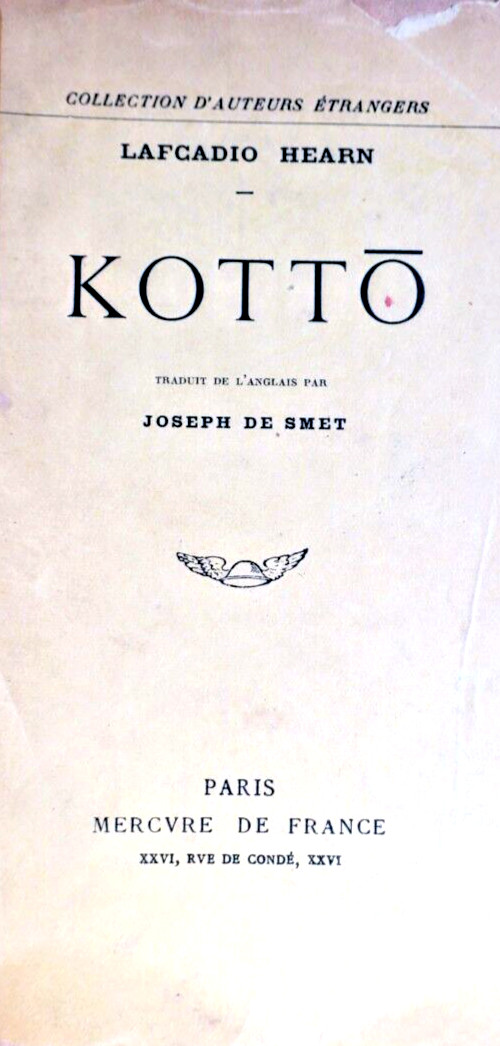
HEARN (Lafcadio), Kotto, Paris, Mercure de France 1912, in-12, 256 pp., paperback, Poor (split spine, would benefit from a fine binding). Collection of tales taken from the Shin-Chomon-Shu, the Hyaku Monogatari or the Uji Jui Monogatari for the older readers. Follow more recent texts: Le journal d’une femme, Lucioles, Gaki, Au cur de la nuit, etc. Biography The middle…
Read full description ↓HEARN (Lafcadio),
Kotto,
Paris, Mercure de France 1912, in-12, 256 pp., paperback, Poor (split spine, would benefit from a fine binding). Collection of tales taken from the Shin-Chomon-Shu, the Hyaku Monogatari or the Uji Jui Monogatari for the older readers. Follow more recent texts: Le journal d’une femme, Lucioles, Gaki, Au cur de la nuit, etc.
Biography
The middle name, Lafcadio, under which Patrick Lafcadio Hearn became known, derives from the island of Leucade, in Greek Lefkada (Λευκάδα), which is part of the group of the Greek Ionian Islands.
Youth
Born to an Irish father, a military surgeon in the British army, and a Greek mother, Patrick Lafcadio Hearn was raised by his aunt in Dublin after the death of his parents. He lost an eye at 16 in an accident while playing with schoolmates. For this reason he avoids showing the side of his head in portraits and photographs of the period. Rejected by his family, he spent time in London, then in Paris.
In the United States
Lafcadio then settled at age 19 in America, first in New York and then in Cincinnati, and became a journalist. There he discovered Japanese culture through contacts with the ambassador of the Empire of Japan.
In 1874, he secretly married Althea “Matthie” Foley, a mixed‑race cook, at a time when mixed marriages were illegal. When the union was discovered, he was dismissed from the newspaper the Enquirer and joined the rival paper, the Cincinnati Commercial.
In 1877, he left Cincinnati and went to Louisiana, to New Orleans. He became interested in the Creole culture of New Orleans and published in 1885 a Creole proverb dictionary, Gombo Zhèbes, and a cookbook, La Cuisine créole.
In Martinique
In 1889, the journal Harper’s Monthly where Hearn worked sent him as a correspondent to the Antilles. He spent two years in Saint‑Pierre, Martinique. The island, which he calls “Pays des revenants,” inspired his novel Youma. Deeply interested in traditional Martinican tales, he collected many and published several works (Trois fois bel conte…, Contes créoles II).
In Japan
At the invitation of his friend, the Japanese ambassador, Hearn arrived in Yokohama in 1890 and found a job as a journalist for the English‑language press. In Japan, Hearn met the daughter of a samurai, Koizumi Setsuko. He married her and, in 1896, took Japanese citizenship and the name Koizumi Yakumo.
Hearn then began writing his works on Japan and Japanese culture. He was especially interested in traditional Japanese ghost stories (yōkai). A great traveler, he moved frequently, living successively in Kobe, Matsue, then Tokyo, where he was appointed university professor. He also climbed Mount Fuji.
He died in Tokyo of a heart attack in
LA LIBRAIRIE ANTIQUE
Independent bookshop since 1995, Paris
Worldwide shipping · SLAM membership pending[*]
[*] Membership of the Syndicate of Antiquarian and Modern Booksellers in progress.
Tell us what is not working, we fix things quickly. The page you are on is attached automatically.