Description
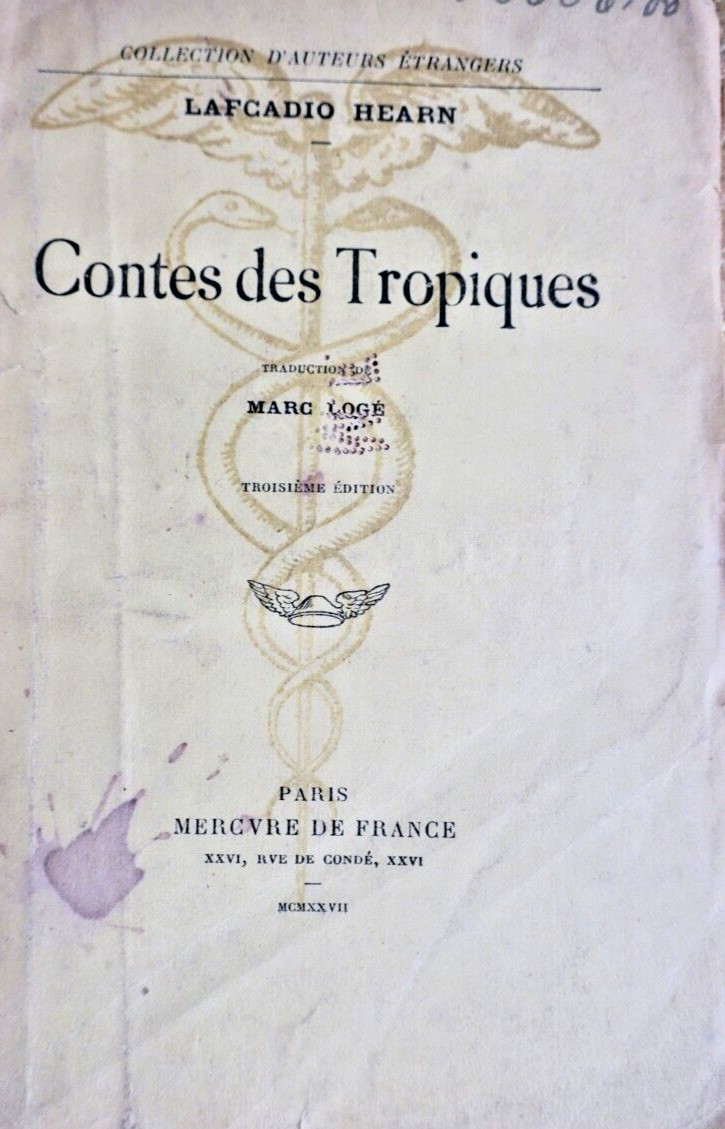
HEARN LAFCADIO
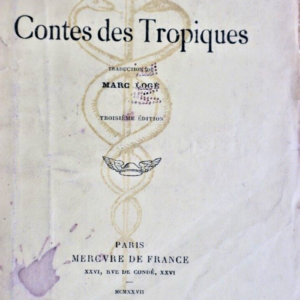
CONTES DES TROPIQUES
Paris, MERCURE DE FRANCE 1926, in-12°, unbound (original covers present), 246 pages, translated by M. Loge
Biography
Lafcadio, Hearn’s second first name, derives from the Greek island of Lefkada (Λευκάδα), part of the Ionian Islands, which in English is known as Leucade.
Early Life
Born to an Irish father, a military surgeon in the British army, and a Greek mother, Patrick Lafcadio Hearn was raised by his aunt in Dublin following the death of his parents. At the age of 16, he lost an eye in an accident while playing with classmates. For this reason, he avoided showing the affected side of his head in portraits and photographs of the time. Rejected by his family, he spent time in London and then Paris.
In the United States
At 19, Lafcadio moved to America, first to New York and then to Cincinnati, where he worked as a journalist. There, he discovered Japanese culture through contacts with the ambassador of the Empire of Japan.
In 1874, he secretly married Althea “Matthie” Foley, a mixed-race cook, at a time when interracial marriage was illegal. When the union was discovered, he was dismissed from his position at the Enquirer and joined the rival newspaper, the Cincinnati Commercial.
In 1877, he left Cincinnati and moved to Louisiana, settling in New Orleans. There, he became interested in the Creole culture of the city and published a Creole proverb dictionary, Gombo Zhèbes, in 1885, as well as a cookbook, La Cuisine créole.
In Martinique
In 1889, Harper’s Monthly, where Hearn worked, sent him as a correspondent to the Antilles. He spent two years in Saint-Pierre, Martinique, an island he described as the “Land of the Dead,” which inspired his novel Youma. Fascinated by Martiniquais folktales, he collected many of them and published several works, including Trois fois bel conte… and Contes créoles II.
In Japan
Invited by his friend, the Japanese ambassador, Hearn arrived in Yokohama in 1890 and found work as a journalist for the English-language press. In Japan, he met Koizumi Setsuko, the daughter of a samurai, whom he married in 1896. That same year, he became a Japanese citizen and adopted the name Koizumi Yakumo.
Hearn then began writing about Japan and its culture, particularly focusing on traditional Japanese ghost stories (yōkai). An avid traveller, he frequently moved and lived successively in Kobe, Matsue, and Tokyo, where he was appointed professor at the university. He also climbed Mount Fuji.
He died of a heart attack in Tokyo in 1904 and was buried according to Buddhist rites. The writer Natsume Sōseki succeeded him as professor of English literature at the University of Tokyo.
Additionally, Hearn introduced judo to America by convincing his friend, then-President Theodore Roosevelt, to invite Yoshiaki Yamashita, a leading expert from the Kodokan, to the United States. This visit sparked a judo craze in America. A great admirer of Pierre Loti, Hearn also translated into English works by Maupassant, Théophile Gautier, Flaubert, Mérimée, Hugo, Zola, Nerval, and Anatole France.
Source: Wikipedia