0
0,00€
An empty cart
You have no item in your shopping cart



480,00€
❦One copy only
As with every antiquarian book, this is the only copy we hold. Once sold, it will not be restocked.
Guaranteed authentic
Every book is examined and described individually by us. Professional booksellers since 1995.
In stock
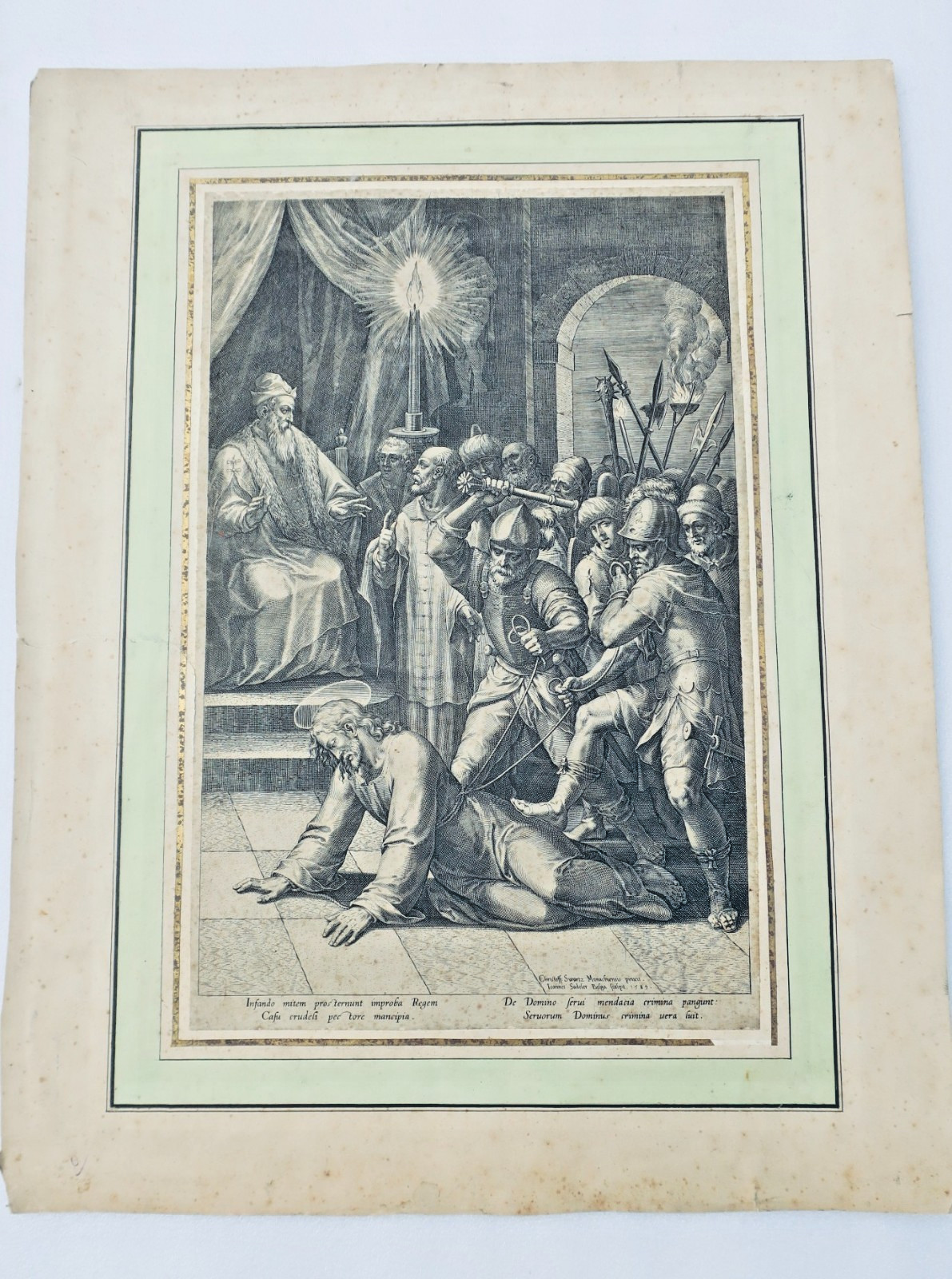
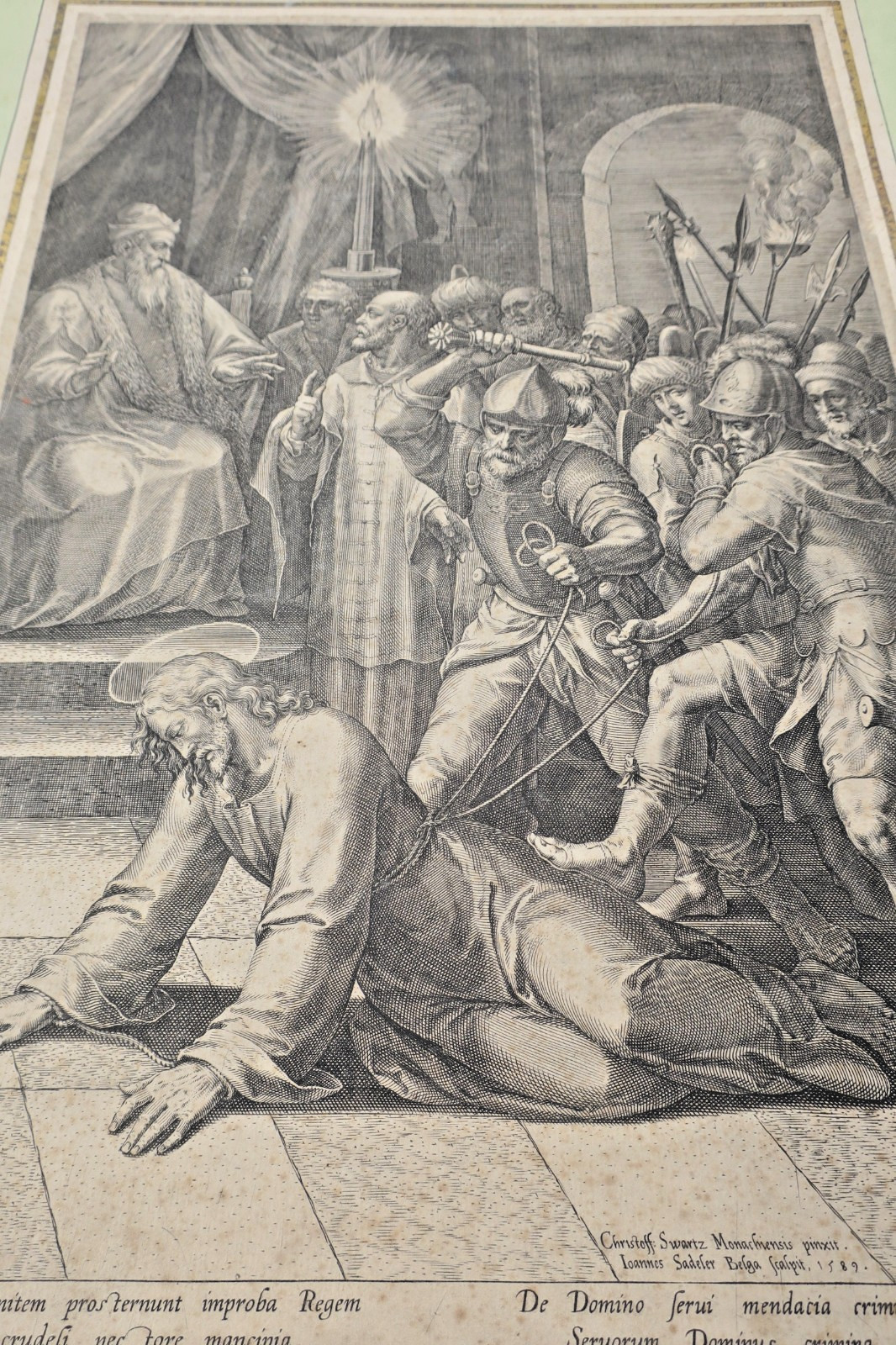
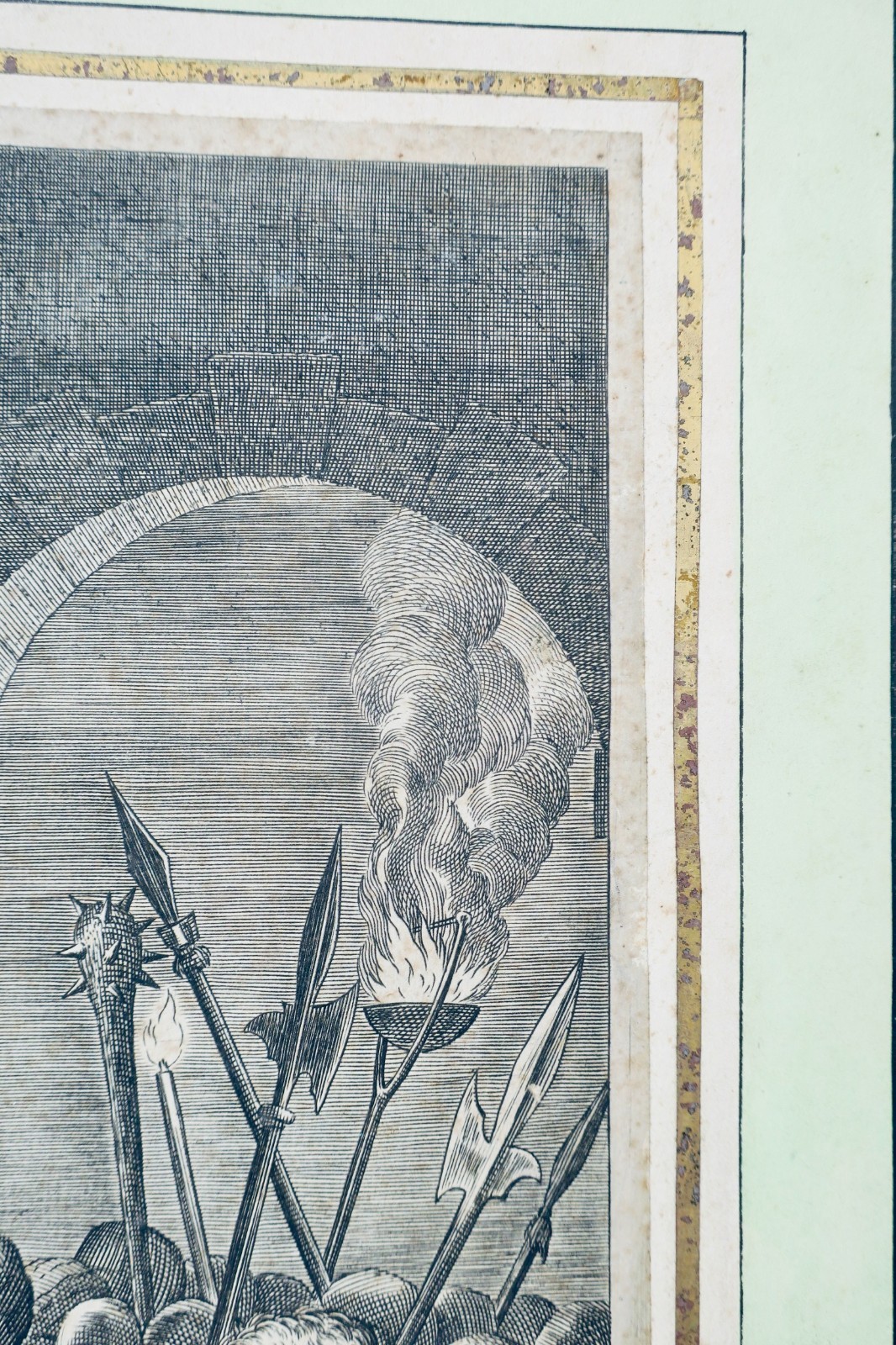
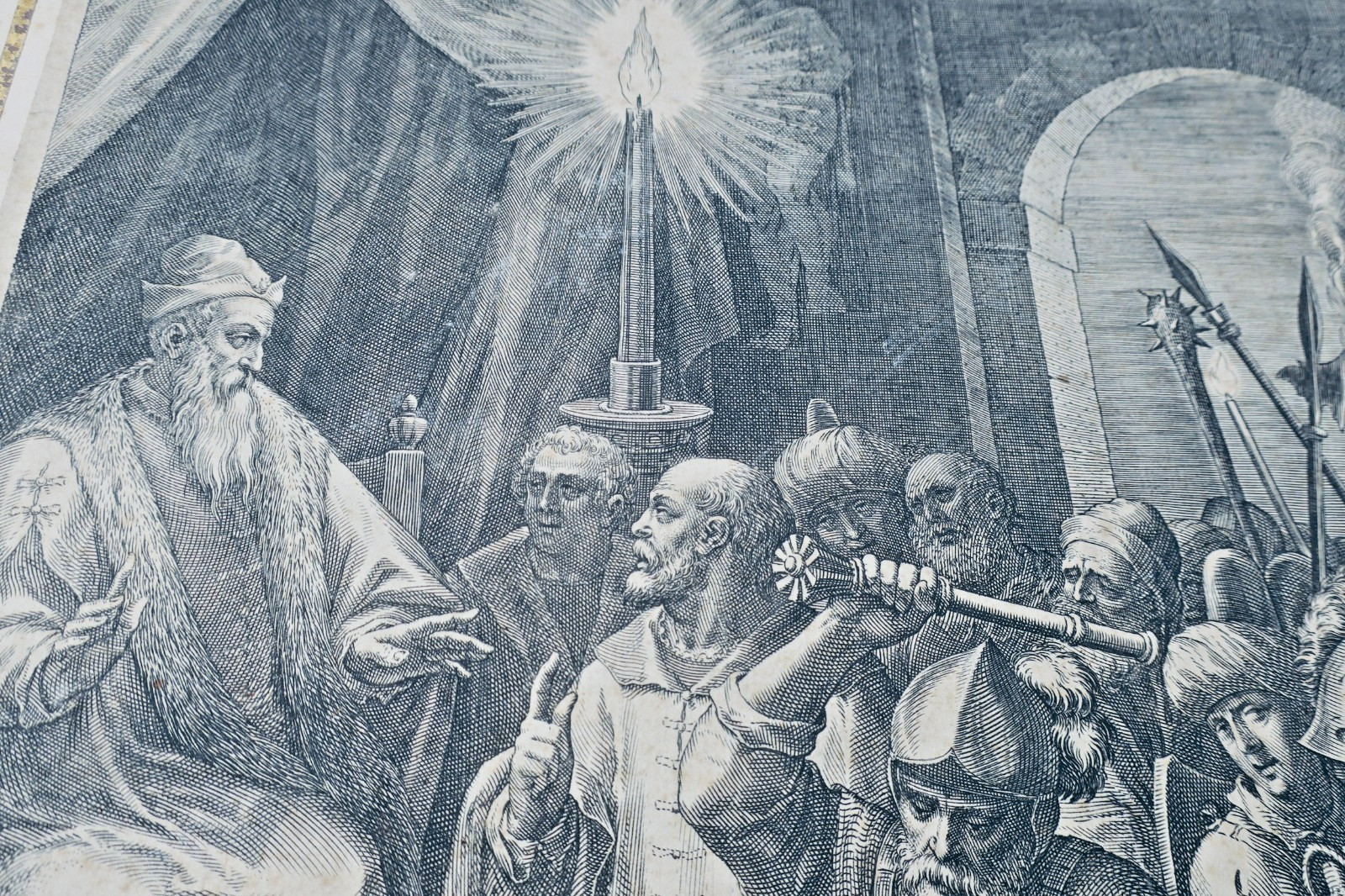
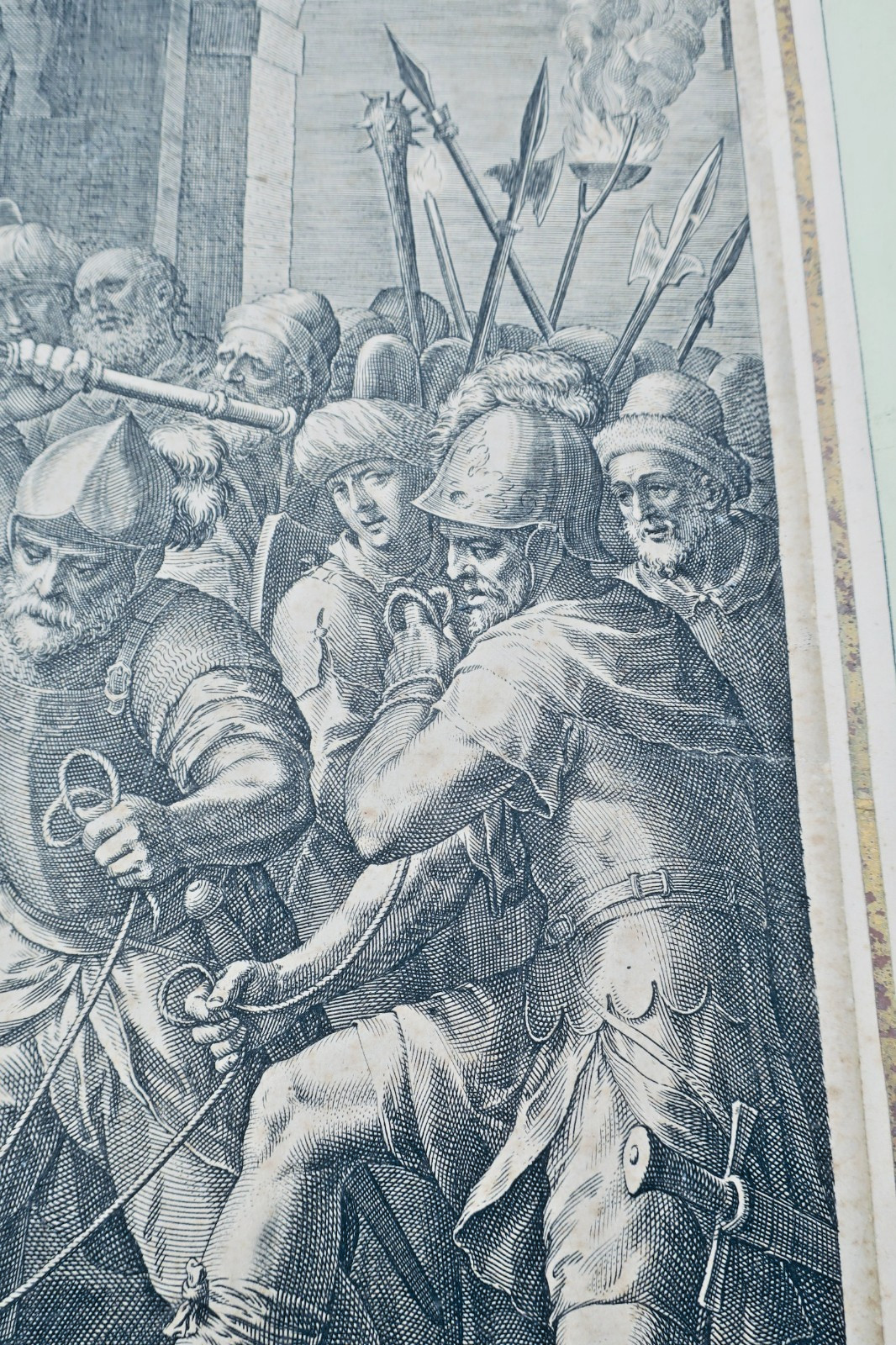
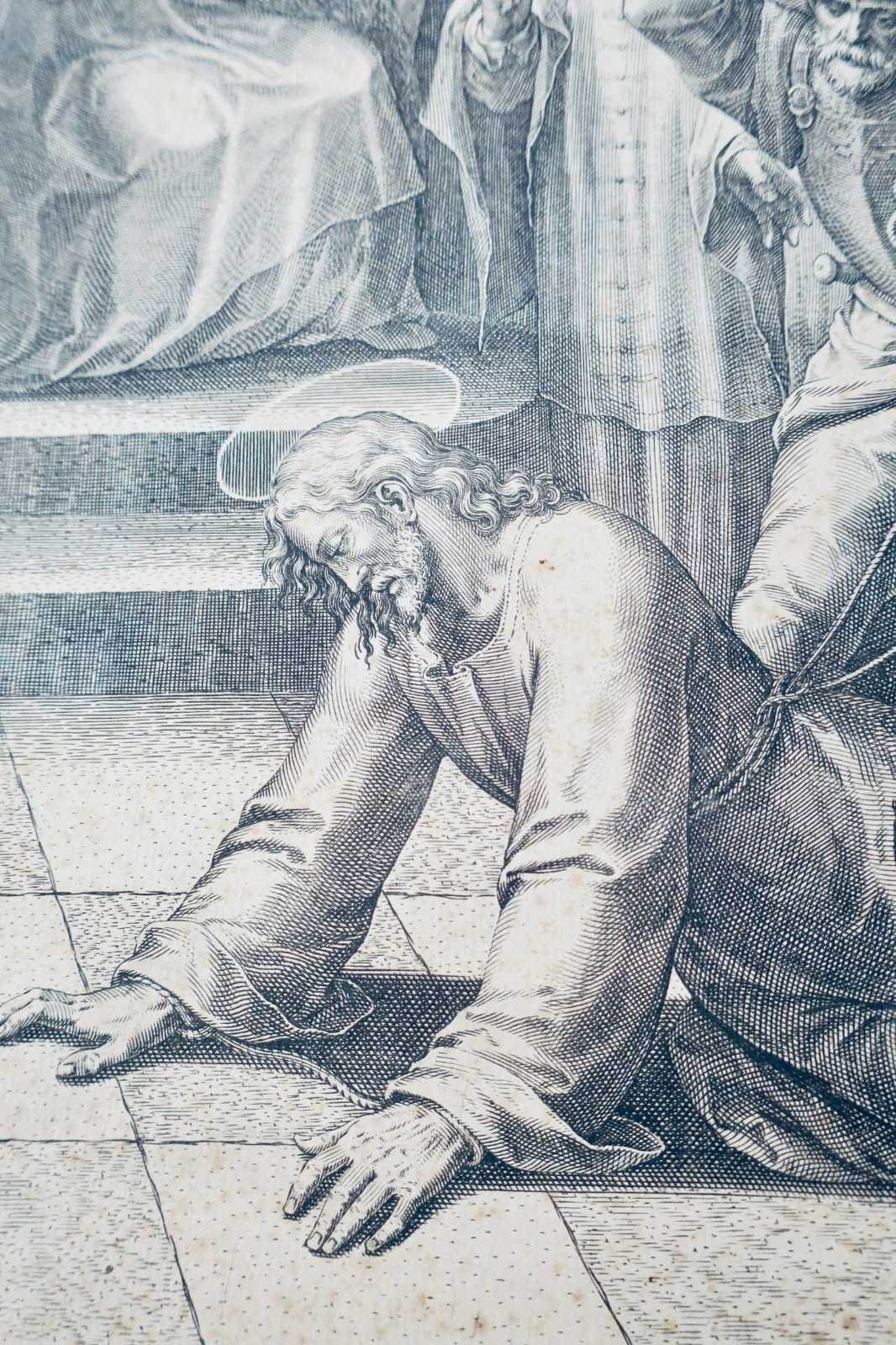
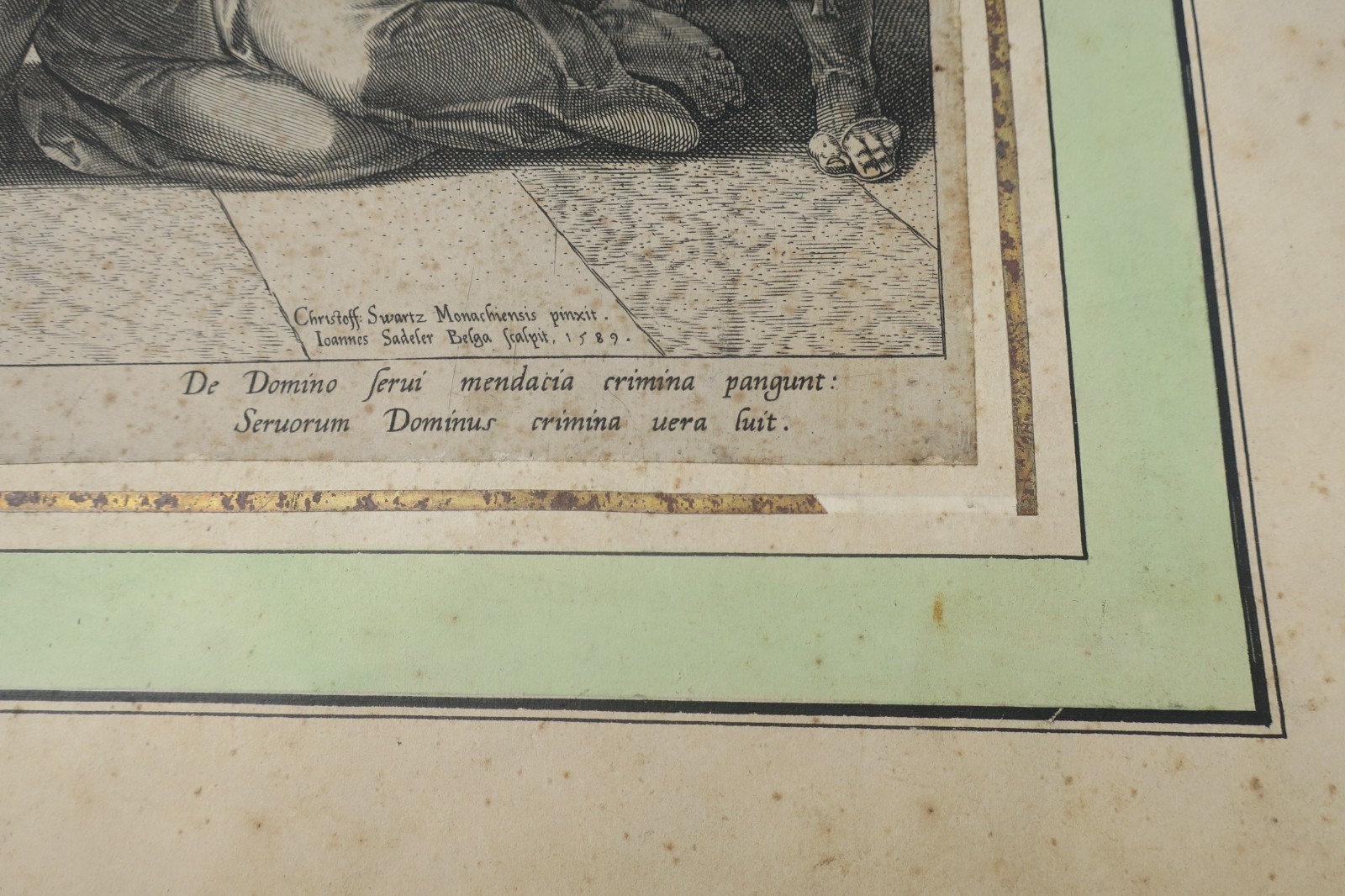
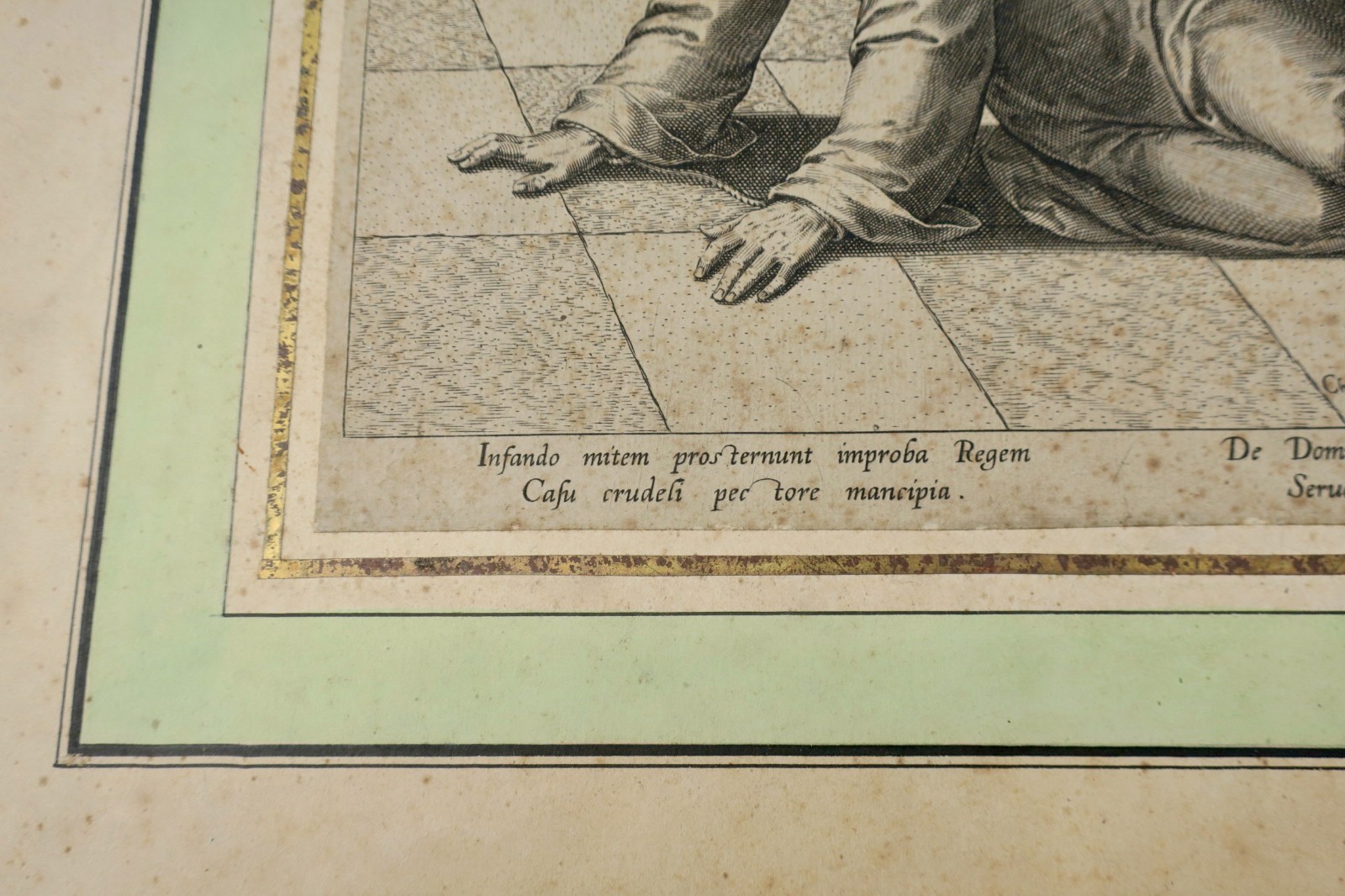
The Christ mocked and struck before the high priest Caiaphas Fine copper engraving by Jan Sadeler 1589 after C. Schwartz, (29 x 44.5 cm.), Latin legends, laid down, (overall plate size on strong paper, 61 x 47.5 cm.), a small tear without loss in the left margin within the border The tormentors who physically abuse Christ here bear the distinctive…
Read full description ↓The Christ mocked and struck before the high priest Caiaphas
Fine copper engraving by Jan Sadeler 1589 after C. Schwartz, (29 x 44.5 cm.), Latin legends, laid down, (overall plate size on strong paper, 61 x 47.5 cm.), a small tear without loss in the left margin within the border
The tormentors who physically abuse Christ here bear the distinctive signs of Roman soldiers: armour, military insignia and powerfully rendered anatomies combine to give them the appearance of formidable legionaries. Yet they act under the gaze of Caiaphas, whose priestly garments identify him without ambiguity and whose gesture—tearing his robes—refers to the episode of Christ’s religious condemnation.
This apparent conflation of protagonists and circumstances cannot be dismissed as mere artistic negligence. On the contrary, it reflects a deeply theatrical conception of the image, characteristic of Mannerist sensibility, which prioritises dramatic intensity, bodily tension and the expressive power of composition. By uniting, within a single pictorial space, the violence attributed to Jewish guards and the visual signs of Roman military brutality, the artist concentrates the various outrages of the Passion into a single, striking and almost suffocating scene.
Such licence with evangelical chronology is particularly revealing of the freedom with which Northern Renaissance artists could treat sacred narrative. Literal fidelity to the sequence of the Gospels gives way here to a different kind of truth: that of emotion, theological meditation and visual impact. The image does not seek to reconstruct the historical circumstances of the Passion with accuracy so much as to condense its violence and spiritual significance before the viewer’s eyes.
It is worth recalling, in this regard, that the Gospels do distinguish two episodes of physical violence, traditionally referred to as the ‘derisions’, which follow one another without merging.
The first derision, of a religious nature, takes place at night, in the house of the high priest Caiaphas, in the presence of the supreme council, the Sanhedrin. Jesus is maltreated there by the Temple guards and servants: he is struck, spat upon, his eyes are covered before he is cruelly parodied, invited to guess the identity of the one who has just struck him. The violence against him takes the form of an humiliation designed to mock his messianic pretensions.
The second derision, of a political and military nature, occurs the following day, in the Praetorium, after Jesus has been delivered to Pontius Pilate. This time it is the Roman soldiers who scourge him, drape him in a purple cloak, place a crown of thorns on his head and put a reed in his hands, a derisive mockery of a sceptre. Through this grotesque staging, they ridicule the title of ‘King of the Jews’ attributed to him.
Thus, the work proceeds by a kind of visual condensation of these two distinct moments of the Passion. By bringing together, in a single scene, the protagonists, gestures and signs belonging to episodes separated by the Gospel narrative, the artist substitutes chronological rigour with a logic that is distinctly pictorial: that of dramatic concentration. The violence of the Passion becomes less a sequence of events than a unified vision of Christ’s humiliation, offered to the gaze and meditation of the faithful.
LA LIBRAIRIE ANTIQUE
Independent bookshop since 1995, Paris
Worldwide shipping · SLAM membership pending[*]
[*] Membership of the Syndicate of Antiquarian and Modern Booksellers in progress.
Tell us what is not working, we fix things quickly. The page you are on is attached automatically.