0
0€
Your cart is empty
You have no items in your cart


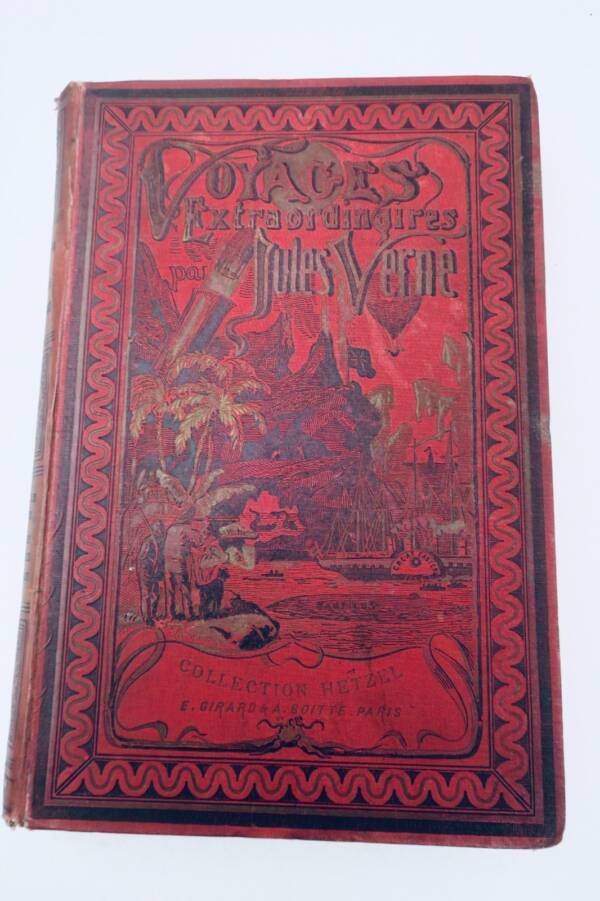
Hetzel’s publisher’s bindings for Jules Verne’s Voyages extraordinaires remain, in my view, the finest playground for 19th-century French illustrated bibliophily. Identifying a type, dating a printing, assessing an item: everything hinges on the decoration of the boards, the publisher’s catalogue on the verso, and the freshness of the gilt. This is the method I use at the counter.

Pierre-Jules Hetzel (Chartres, 1814 – Monte-Carlo, 1886) founded his first firm in 1837. A republican proscribed after Louis-Napoleon’s coup d’état, he went into exile in Brussels from 1851 to 1859, then returned to Paris to rebuild his business. In 1864 he launched, with Jean Macé, the Magasin d’éducation et de récréation, a bi-monthly periodical that ran until 1906 and served as the template for French children’s literature.
The meeting with Jules Verne in 1862 changed everything. Hetzel bought Five Weeks in a Balloon, signed a contract in 1863 that would bind Verne to the house for nearly forty years, and launched the series of the Voyages extraordinaires. On his death his son Louis-Jules took over; the firm was finally acquired by Hachette in 1914.
The series comprises 62 titles labelled “Voyages extraordinaires,” of which 54 were published during Verne’s lifetime between 1863 and 1905, and 8 posthumously up to 1919. Each title first appeared in original wrappers in-18°, then in the large illustrated in-8° format—the celebrated “Magnier” style—and finally in polychrome publisher’s bindings intended for the Christmas gift market.
This seasonal logic explains it all. Every autumn Hetzel issued one or two new titles and reissued older ones, dressed in a luxury binding sold at a higher price than the paperback. The board decoration followed fashion, evolving every five to ten years, which has created the typology documented since the pioneering work of Bernard Bottin (1978) through to the standard reference volumes by Philippe Jauzac. To place Verne in his serial context, see our article on collecting the Voyages extraordinaires.
Books for sale on this subject
Bibliographers list about twenty board variants, but six dominate the market. Here is how to tell them apart at a glance.
Polychrome, red background, a large gold-stamped terrestrial globe at the centre with the inscription "Voyages extraordinaires". Binding attributed to the Engel workshops based on Souze’s designs. This is the archetype, the one spontaneously associated with Verne. Very sought-after and in very fine condition, with unoxidised gilt.
Front cover featuring two facing elephants, title cartouche in reserve. Very rare, and notable fact: it exists only in red. Used for La Maison à vapeur (1880) and a few contemporary titles. One of the most coveted in the corpus.
Green background, an elephant to the left, foliage covering the entire cover, title in a fan. Appears with L’Invasion de la mer and Le Phare du bout du monde. This is the decoration that marks the final cloth bindings of the Louis-Jules Hetzel era.
Polychrome cloth binding, front cover adorned with a medallion portrait of Jules Verne surrounded by scenes from the Voyages: balloon, Robur, Nautilus. Spine featuring a lit lighthouse. This is the “synthesis” binding, regularly appearing at auction between €1,500 and €8,000 depending on title and condition.
Variants with unfurled banner or gilt medallion world map. More discreet than the gilt globe, often used for mid-catalogue reprints. Careful examination of the spine is essential to avoid confusion with other types.
Several transitional cloth bindings, including the “with shell” type struck with a gilt projectile recalling De la Terre à la Lune, or the “steamer” and “fan” variants. Decorations sometimes unique to a single title, hence highly sought-after.
| Type | Dominant period | Rarity index |
|---|---|---|
| With gilt globe | 1870s–1890s | Common in fair condition, rare in very fine condition |
| With two elephants | Early 1880s | Rare, only in red |
| With one elephant | From 1905 | Marks the final print runs |
| With portrait / lighthouse | 1890s–1900s | Moderately rare, highly sought-after |
| With banner / world map | 1890s | Common |
| With shell and late types | Variable periods | Often unique to the title |
This is the definitive method, and the one systematically used by auctioneers. The publisher’s catalogue appears at the end of the volume, sometimes as a separate booklet. It lists the titles available for sale that year, and the most recent title fixes the terminus a quo for the copy.
An example. A cloth binding with a “gilt globe” for Vingt mille lieues sous les mers whose publisher’s catalogue stops at Mathias Sandorf (published in 1885) therefore dates from 1885 or 1886, not earlier. If the catalogue lists Robur le Conquérant (1886), the date moves back one notch. This seemingly minor detail can make the price vary by a factor of three to ten between an early cloth-bound printing and a late reprint.
The last title listed in the final publisher’s catalogue gives the earliest possible date for the copy. Cross-reference with the style of cloth binding: a binding “with an elephant” claiming to date from 1885 is necessarily a fake or a late assembly.
The Hetzel market is one of the most active in illustrated bibliophily. The Pierre Jacob sale at Drouot in 2021 dispersed nearly 300 volumes for about €277,000 including fees; two copies of Le Tour du monde en quatre-vingts jours in rare colour bindings each exceeded €28,000, and a previously unknown cloth binding “with a mirror” of Hector Servadac fetched nearly €18,000. These figures are available in the published sale reports from Drouot.
Five criteria shape prices:
The Hetzel cloth binding is a publisher’s binding in polychrome calico (percaline), mass-produced by the Engel workshops for most designs and by Lenègre for certain motifs such as elephants. The boards are formed by hot-stamping, the decoration combining gilt tooling and polychrome impressions in solid colours. The edges are gilt on three sides, sometimes chiselled on deluxe copies. For an overview of the technique, read our guide Cloth bindings and percaline in the 19th century.
The endpapers are of glazed paper, chamois yellow in early printings, later fading to pale blue or cream depending on the period. The presence of original, un-replaced endpapers is a strong indicator of a first printing. On later "one elephant" bindings, printed endpapers with geometric patterns can also be encountered.
Three recurring traps come up at my counter.
First, assemblages. A binder may have reused an old Hetzel binding to rebind a later text, or vice versa. The only guarantee is the consistency between binding type, publisher’s catalogue and the date of the text. Our complete method for identifying a first edition applies word for word.
Next, hidden restorations: spine renewed, hinges re-sewn, gilt edges touched up. Depending on the extent, these interventions can reduce the value by half to a fifth. Always ask for a detailed description and insist on photos of the hinges and joints.
Finally, facsimiles and reprints. Hachette’s re-editions from the 1960s–1970s, and more recent "patrimoine" editions, sometimes mimic Hetzel’s decoration without the quality of stamping or the fineness of the paper. Our guide on facsimiles and counterfeits details the tell-tale material clues.
Indicative price ranges observed in recent public sales, copies in good condition with fresh gilt. To be taken as guidelines, not as a fixed scale.
| Title / type | Good | Very good | Exceptional copy |
|---|---|---|---|
| Cinq semaines en ballon, au globe dore | £300 - £600 | £1,200 - £2,500 | £5,000 and above |
| Vingt mille lieues sous les mers, premier cartonne | £800 - £1,500 | £3,000 - £6,000 | £15,000 and above |
| Le Tour du monde, couleur rare | £1,500 - £3,000 | £8,000 - £15,000 | £28,000 (2021 record) |
| Late titles "a un elephant" | £150 - £400 | £500 - £1,200 | £2,000 - £3,500 |
| Posthumous titles (1906–1919) | £200 - £500 | £800 - £1,800 | £3,000 and above |
If you own a Hetzel and want to be sure, we offer a free and confidential valuation. We also buy complete collections: see sell or value your books.
Open the volume to the publisher’s catalogue at the end of the book. Locate the most recent title listed and check its publication date. If it matches the year of publication of the text (or immediately follows it) and the style of binding is consistent with that period, you have a first cardboard binding edition. Otherwise, it is a later reprint.
The red is the standard production colour for Hetzel, and therefore the most common. Green, blue, and even more so the polychrome bindings in rare colours (pink, plum, bright yellow) are more limited print runs, and the market values them significantly higher. For the same title and condition, the colour premium can reach a factor of two to five.
Do nothing invasive. A failed touch-up dye job, a re-inked spine or a complete spine restoration will reduce the value. Store the book flat, away from direct light, and have it appraised before any intervention. Our guide when to entrust an old book to a restorer provides the right steps.
Yes, but less than titles published during Verne’s lifetime. The eight posthumous titles (1906–1919), including Le Phare du bout du monde and Le Volcan d'or, are collected mainly in “one elephant” bindings. They allow completion of a set at a reasonable price, except for a few exceptional copies.
Both have advantages. At auction, prices may be attractive but descriptions are sometimes brief, and restorations rarely mentioned. In a specialist bookshop, you pay for expertise but receive a written guarantee and a detailed condition report. For purchases over €1,000, a bookseller is the safer choice.
Red, green or polychrome binding, first edition or late reprint: we provide free appraisals and purchase high-quality copies. Request an appraisal – response within 48 hours.
Tell us what is not working, we fix things quickly. The page you are on is attached automatically.