0
0€
Your cart is empty
You have no items in your cart


The raised bands, cords, and sewing form the hidden mechanics of an old book: what holds the gatherings upright, withstands five centuries of openings, and betrays the era as surely as the binder’s hand. Understanding this framework is to read a volume not just by its cover.
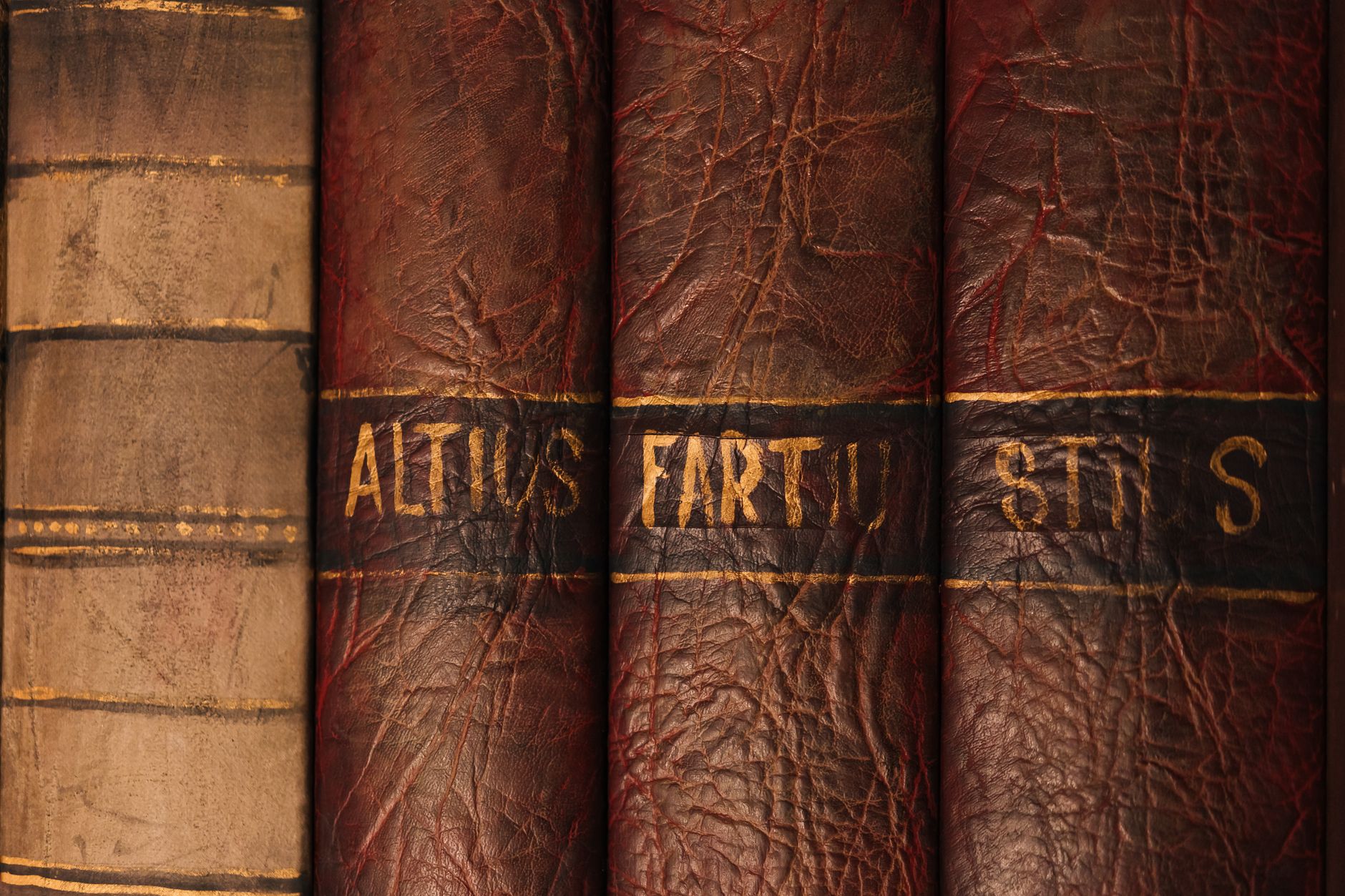
Before the morocco leather dresses the spine, everything begins with a thread. The binder stacks the gatherings on a sewing frame, then pierces them one by one, looping the thread around vertically stretched supports. These supports are the raised bands, and their nature has changed greatly over time. In the earliest Western codices, sewing was done on genuine animal sinew, then on strips of skin, rolled parchment tongues, and finally on septain, a multi-strand twisted hemp cord. The BnF documents this evolution in its medieval manuscript restoration workshops.
The operation seems mechanical. It is not. A poorly pierced gathering, and the thread will cut through the paper after a few openings. Too much tension, and the spine will warp. Too loose, and the book will gap. This is why hand-sewn bindings by a skilled workshop can endure four centuries, whereas industrial bindings of the 20th century sometimes fail within decades.
For centuries, nearly all books bound in Europe were sewn on visible raised supports at the spine. Then came the 19th century, its industrialisation, its production pace, and with them the tapes sewing method, which transformed the economics of the workshop. Tapes, wider and quicker to attach than cords, allowed a volume to be sewn in far less time. The downside: they are no longer laced into boards but cut flush and glued into the pastedowns. The assembly gains speed, but loses longevity, especially for large formats.
Sewing on raised bands remains the gold standard for fine bindings. The thread wraps around each band with every gathering, creating a flexible yet durable hinge. As the spine rounds, the bands form the characteristic ridges that structure the compartmentalisation of the raised bands. The great binders of the 19th century never abandoned this technique for their luxury commissions.
| Criteria | Sewn on raised cords | Sewn on tapes |
|---|---|---|
| Dominant period | 15th to 18th century | From the 19th century onwards |
| Support | Hemp cord, tawed skin | Cotton or linen tape |
| Attachment to boards | Laced into boards (through) | Trimmed flush and glued |
| Spine appearance | Visible raised cords | Flat spine |
| Sturdiness for large formats | Excellent | Limited |
| Workshop cost | High, slow | Reduced, fast |
The number of cords is never decorative. It depends on the format, the weight of the book, and the length of the spine. Workshop practice dictates that each cord should support an equivalent portion of gatherings; otherwise, the mechanics become unbalanced. In general, European production from the 17th to the 19th centuries observes the following:
The widespread adoption of the octavo format, popularised by Aldus Manutius in Venice at the very beginning of the 16th century, established for generations the standard of a four- or five-cord spine. If you encounter a 17th-century octavo with six cords, be wary or curious. It is either a bibliophile’s whim or a late rebinding by a workshop eager to make an impression.
Since the 19th century, false cords have gained ground. In these bindings, the gatherings are sewn onto cords inserted into grooves of a hollow back, producing a smooth spine initially. The binder then glues strips of board or leather over these to mimic the raised cords of genuine bindings. The result is deceptively similar to an old binding, but the structural function is lost: they are merely decorative bosses.
To distinguish them, open the book flat and examine the inside of the spine if the binding allows. A true cord runs from board to board, passing through the gatherings; a false cord stops at the spine. Another easily visible clue is the perfect regularity of false cords, aligned with precision, whereas true cords always show minute irregularities, traces of handwork. On 17th-century Jansenist bindings, false cords never appear. On common editions from the Second Empire, they almost always do.
Five raised bands on an 18th-century octavo, classic structure. Four raised bands on a 19th-century book with smooth spine imitating raised bands, almost always false. Three raised bands on a folio, worn binding or poorly executed work.
At the very top and bottom of the spine, an embroidered cord emerges between the compartments. This is the headband. Its function is twofold: it reinforces the assembly of the gatherings at the head and tail, where mechanical stress is greatest, and it strengthens the joints, those vulnerable areas whenever a volume is pulled from the shelf. The glossary of bookbinding lists several types, ranging from a simple wrapped thread to multi-level embroidery.
The materials vary. Silk for deluxe bindings, linen or hemp for standard ones, dyed thread for refined commissions. Some royal headbands from the 17th century use gold or silver thread, traces of which can still be seen in armorial bindings preserved at the BnF. Hand-embroidered headbands come in several styles:
A missing, crushed, or mechanical headband made of simple glued paper is among the quickest indicators to assess a binding. On the market, an 18th-century volume with its original headbands intact is worth significantly more than the same title whose joints have been restored in the 19th or 20th century.
Once the gatherings are sewn and the headbands are in place, the bookbinder adds the endpapers. These are the blank or marbled sheets that open and close the volume, serving both as physical protection for the first gathering and as a flexible zone for the movement of the binding. Before the 18th century, endpapers are mostly white or patterned paper. The rise of marbled paper, imported from the East via Venice and later produced in France from the 17th century, changed the game: it became the standard endpaper in the second third of the 18th century.
The pastedown is the half of the endpaper glued to the inside of the board. It conceals the passage of the raised bands on the board and provides the first interior impression. In fine bindings, this pastedown is replaced by a lining of luxury material: gilt paper, embroidered silk, or sometimes leather lined with another leather. These linings almost always indicate a high-end commission, and their condition heavily influences valuation. For further reading on terminology, see our complete anatomy of the ancient book.
When you pick up a volume, first look at the spine. Count the raised bands, assess their regularity, and check whether they are real or false. Then open to the first endpaper and gently pivot the boards: if the spine cracks sharply, the sewing is likely damaged. If the gatherings fan out without tension, the sewing is loose or the spine glue has dried out. A good binding is recognised by its clean opening, without harsh resistance or floppiness.
In the bindings featured in our catalogue, these checks always determine the valuation. A Bradel binding with its original headband commands a different price than a later rebound copy. If you are unsure about an inherited volume, our team can examine it without obligation, or you may send it directly via our sell and valuation page.
Several converging clues. A new, bright white thread that contrasts with the paper’s patina. Double stitching, evidence of a second sewing over the original. Overly uniform tension, sometimes mechanical. And above all, modern headbands poorly matched to the spine leather, their colour clashing with the rest.
Yes, significantly, especially if it leads to damaged corners. On an 18th-century binding in generally good condition, the loss of a headband can reduce the valuation by several tens of percent depending on the title and rarity. Professional restoration is possible but should remain discreet and reversible.
The bibliophile’s rule is that an original binding, even worn, is more valuable than a 19th- or 20th-century rebound one. One exception: if the original was a modest paperboard binding with no interest, a fine later binding signed by a major workshop can conversely enhance the volume’s value.
Check the regularity. Four or five perfectly aligned ridges, spaced to the millimetre, with no roughness: false ribs. Slightly uneven ridges, with micro-bosses visible in raking light: true ribs. If in doubt, slide your fingernail under the headband to feel whether the rib extends to the boards or stops at the spine.
La Librairie Antique examines your inherited or flea-market-acquired volumes free of charge. We inspect the sewing, the raised bands, the headband and the overall mechanics before making any proposal.
Tell us what is not working, we fix things quickly. The page you are on is attached automatically.