0
0€
Your cart is empty
You have no items in your cart


At La Librairie Antique, we receive every week customers convinced they hold a rare first edition. Often, their enthusiasm is met with a more nuanced reality: reprints, later print runs, or revised editions. The difference between a true first edition and a simple reprint can multiply the value by ten, or even a hundred. An original copy of Du côté de chez Swann (Grasset, 1913) in good condition can fetch between €15,000 and €30,000, while a 1920s reprint will not exceed €200. Recognising a first edition is therefore not an academic exercise: it is the first skill of the bibliophile.
This guide provides the keys to systematically identify a first edition. We will cover the visual elements to examine, the specific markings of major French publishers (Gallimard, Grasset, NRF, Mercure de France, Hetzel), the codes of the 19th century, and the most common pitfalls. Each step will be illustrated with concrete examples, such as this Vingt mille lieues sous les mers by Jules Verne (Hetzel, 1869-1870), whose first edition in three red and gold cloth-bound volumes regularly reaches €8,000 at auction, or this Voyage au bout de la nuit by Céline (Denoël, 1932), whose well-preserved first edition can fetch nearly €15,000 today. Learning to recognise a first edition requires patience; the rewards, however, last a lifetime of collecting. Our article “how to appraise an inherited antiquarian book” usefully complements this guide for heirs.
The first edition, or editio princeps, represents the initial state of a text. It often bears the marks of literary creation: typos corrected later, textual variants, or even passages censored in reprints. For collectors, it embodies absolute authenticity. A Les Misérables (Lacroix, 1862) in first edition sells for €12,000, compared to €50 for a 1930s Larousse reprint. This gap alone sums up the stakes of knowing how to recognise a first edition.
The value also depends on historical context. First editions published during the author’s lifetime are the most sought after. A complete À la recherche du temps perdu (NRF, 1913-1927) in seven volumes can exceed €100,000. Posthumous print runs, even numbered ones, lose 70 to 80 % of their value. Our guide “collecting Proust: In Search of Lost Time” details volume by volume the identification of this series.
LLA_SC_ The British market offers a useful point of comparison. Anglo-Saxon “first editions” follow similar criteria, but with their own particularities: the explicit mention of “First Edition” printed on the title-page, or the presence of the full date on the title-page. The British Library provides reference sheets for English first editions. In the United States, the Library of Congress maintains valuable bibliographies for identifying an American first edition. Major American publishers (Knopf, Scribner, Harper & Brothers) used their own codes — colophon, numbering, first edition points — which the French tradition never fully adopted.
LLA_SC_ The title-page contains 80% of the information needed to recognise a first edition. Below are the elements to analyse systematically.
LLA_SC_ First element: the publication date. LLA_SC_ It must correspond to the year of first publication. To identify a first edition of Le Petit Prince (Gallimard, 1943), any later date indicates a reprint. Be wary of impressions dated the same year, a frequent occurrence with Hetzel: Verne sold so well that several print runs followed within weeks of release.
LLA_SC_ Second element: the absence of the mention “nouvelle édition” or “édition revue”. LLA_SC_ A first edition never carries these indications. Mentions such as “édition définitive” or “texte conforme à la volonté de l’auteur” always signal a reprint, sometimes issued after the author’s death.
LLA_SC_ Third element: the name of the original publisher. LLA_SC_ Some works change publisher after the first edition. Madame Bovary was published by Michel Lévy frères in 1857, then by Charpentier in 1873. Les Fleurs du Mal was issued by Poulet-Malassis in 1857, then by Hetzel in 1861. Knowing the original publisher is essential to recognise a first edition.
LLA_SC_ Fourth element: the presence of a mention “Édition originale” or “EO”. LLA_SC_ Some houses state it explicitly (Mercure de France, Grasset). Others use visual codes, such as the NRF with its characteristic red band.
LLA_SC_ Fifth element: typography and layout. LLA_SC_ First editions often feature denser composition with period-appropriate typefaces. Modern reprints use reset fonts that reveal their date. To identify a first edition at a glance, compare the layout with a known reference.
Sixth element, dedications or special mentions. An autograph inscription (To my friend X) or the mention “Exemplaire de presse” considerably increases the value. Les Thibault (NRF, 1922-1940) with an autograph inscription by Roger Martin du Gard are traded around €5,000.
Take the example of a Thérèse Desqueyroux (Grasset, 1927). To identify a first edition, one must check the date 1927, the mention “Les Cahiers Verts” (original series), the absence of any edition number, and a colophon dated 15 October 1927. A reprint from the 1950s will display “Nouvelle édition” and a later colophon. This methodology applies to most modern titles: it is by examining known copies that the eye becomes trained.
Books for sale on this subject
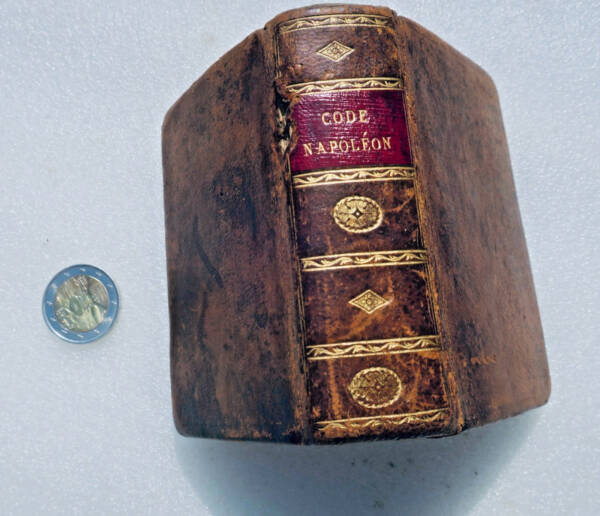 CODE NAPOLEON, First and Sole Official Original Edition 1810440€ View details ›
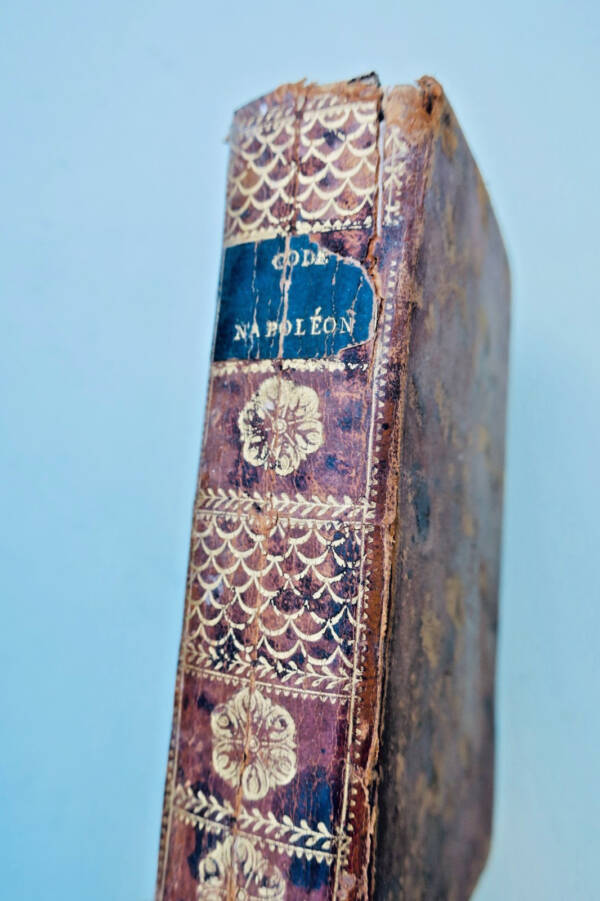 Code Napoleon according to the original 1807 Imprimerie Impériale miniature edition360€ View details ›
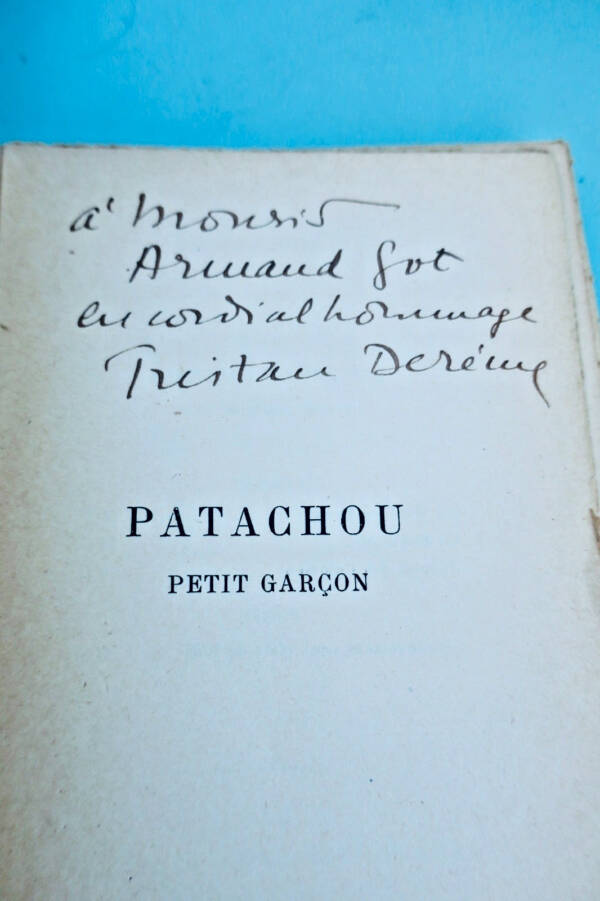 Tristan Derème Patachou. Little boy. First edition inscribed90€ View details ›
 The Dead Donkey - Original illustrated edition65€ View details ›
The colophon, usually located on the verso of the title page or at the end of the work, is the most reliable proof for identifying a first edition. It is a mandatory mention indicating the date the printing was completed, the printer’s name, and sometimes the print run. The standard format is as follows: “ACHEVÉ D’IMPRIMER LE 15 MARS 1913 SUR LES PRESSES DE L’IMPRIMERIE X POUR LES ÉDITIONS Y”.
Three elements are key to recognising a first edition from the colophon. The date must match the year of publication. The printer’s name provides valuable clues: Chaix for Gallimard, Mame in Tours for Grasset, Crété in Corbeil for several publishers. The mention “Premier tirage” or “Tirage de [nombre] copies”, when present, confirms a first edition.
Publishers vary in their conventions. Gallimard often uses the formula “ACHEVÉ D’IMPRIMER EN [MONTH] [YEAR] PAR L’IMPRIMERIE CHAIX”. The NRF sometimes simply states “IMPRIMÉ EN [YEAR]” without a precise date. Hetzel signs “IMPRIMÉ PAR JULES HETZEL ET Cie” for first editions. Grasset systematically uses Mame in Tours, with the printer’s signature at the end of the volume.
A Voyage au bout de la nuit (Denoël, 1932) with a colophon dated 10 October 1932 on the presses of Crété in Corbeil is a first edition. A colophon dated 1933 or later indicates a reprint, despite the same date on the title page. This distinction makes all the difference in price: a fake first edition of Voyage is worth €200; the genuine one reaches €15,000.
The legal deposit, when it exists, provides additional confirmation. For books published after 1925, it is usually found on the verso of the title page or at the end of the work. A legal deposit from 1942 for L’Étranger (Gallimard) confirms a first edition, while a deposit from 1945 indicates a reprint. The legal deposit number can be consulted on Gallica, which offers a valuable database for verifying editions.
Each French publishing house has developed its own codes to identify first editions. Recognising a first edition necessarily involves knowing these house conventions.
Gallimard and the NRF. The red dust-jacket band is the visual signature: present on first editions up to the 1950s, with the words “Nouvelle Revue Française” in capital letters. The mention “NRF” itself is systematic for first editions before 1945. The colophon is always printed by Chaix in Paris or Crété in Corbeil. La Condition humaine (1933) should bear the red NRF dust-jacket band and a colophon dated 15 March 1933. The “Blanche” series houses most of the literary first editions.
Grasset. The “Les Cahiers Verts” series contains most of the literary first editions between 1921 and 1939. The binding is green with the title in black, the format is in-16. The words “Édition originale” often appear at the foot of the title page. The colophon is printed by Mame in Tours. Le Nœud de vipères (1932) bears the mention “Cahiers Verts no. 12” and a colophon dated 5 November 1932.
Mercure de France. To recognise a Mercure first edition, the words “Édition originale” are almost always present on the title page. The justified print run is indicated (“Tirage à 1 500 exemplaires”). Some copies are on large paper (pure vellum, Dutch, imperial Japan). Les Caves du Vatican by André Gide (1914) is an emblematic example with its 1 000 copies.
Hetzel. The red and gold cloth binding is characteristic of Jules Verne’s first editions. The words “Bibliothèque d’Éducation et de Récréation” appear on first editions. The colophon always reads “PAR JULES HETZEL ET CIE”. Le Tour du monde en quatre-vingts jours (1873) should feature red and gold cloth binding with a colophon dated 30 November 1872.
Fasquelle et Charpentier. The “Librairie Charpentier” series houses first editions of Zola. The phrase “Édition définitive” is absent from first editions—it appears only on reprints. The colophon is by Lahure or Crété. Germinal (1885) bears the “Librairie Charpentier” imprint and a colophon dated 25 February 1885.
For nineteenth-century books, the phrase “Édition originale” is rare. One must then rely on the date, publisher and colophon. A copy of Les Misérables (Lacroix, 1862) with a colophon dated 3 April 1862 is a first edition, even without explicit mention. Our guide “Collecting Victor Hugo: First Editions” elaborates on these criteria for the poet’s work.
Information on the print run provides crucial clues for safely identifying a first edition. The justified print run indicates the total number of copies printed. La Nausée (Gallimard, 1938) bears the note “Tirage à 3 000 exemplaires.” Limited print runs, around 500 copies, are more sought-after: Le Parti pris des choses by Francis Ponge (Gallimard, 1942) with its print run of 500 copies is a prime example.
Large-paper copies require separate examination. These are copies printed on luxury paper—pure vellum, Dutch, imperial Japan, China—usually limited to 50 to 200 copies. À l’ombre des jeunes filles en fleurs (NRF, 1919) exists in large-paper format on imperial Japan, limited to 100 copies, which sell for ten to twenty times the price of the regular issue. Pure vellum is a smooth, grainless paper. Dutch paper is a thick laid paper. Imperial Japan is a tinted paper with characteristic fibre inclusions.
When identifying a first edition from numbering, beware: not all numbers signify a first edition. Copies outside commerce are reserved for the author or publisher, marked “HC” or “Service de presse.” Les Thibault (NRF, 1922) with an inscribed presentation is worth €3,000 in outside-commerce condition. Numbering alone is not enough to guarantee a first edition. One must verify that the numbering corresponds to the first print run and that it is printed (never handwritten). Le Grand Meaulnes (Émile-Paul, 1913) numbered 1 to 1,000 is a first edition; numbers 1,001 to 2,000 are a 1914 reprint.
A copy of Du côté de chez Swann (Grasset, 1913) with the note “Tirage à 1 200 exemplaires” and a colophon dated 14 November 1913 is a first edition. The same note with a colophon dated 1914 indicates a reprint. This subtle distinction, invisible to the untrained eye, shifts the value from €30,000 to less than €1,000.
Books from the 19th century follow different rules. Without the mention “Édition originale” (first edition), one must rely on a set of clues.
To identify a first edition from the 19th century, first rule: the absence of any edition statement. First editions from the 19th century never bear “1ʳᵉ édition” (first edition) or “Édition originale” (first edition). Notre-Dame de Paris (Gosselin, 1831) has no such mention. Second rule: the date of the achevé d’imprimer (completed printing) must match the year of publication. Les Misérables (Lacroix, 1862) should show an achevé d’imprimer dated 3 April 1862. Third rule: the original publisher must be identified. Les Fleurs du Mal (Poulet-Malassis, 1857) then Hetzel (1861) — only Poulet-Malassis is the original publisher.
To spot a first edition at a glance, period binding is a valuable visual clue. These are bindings in percaline, with raised bands, decorated boards in colours (red, green, blue, brown) and gilt tooling. Les Contemplations (Hetzel, 1856) in red and gold cloth binding is a hallmark of a first edition. Laid paper, with its watermark visible when held to the light, confirms the period. La Comédie humaine (Furne, 1842-1855) is printed on laid paper with the “Furne” watermark.
The half-title, present in most first editions of the 19th century, deserves close examination. It is a separate page placed before the title page. Le Père Goriot (1835) bears the half-title “Scènes de la vie privée” (Scenes from Private Life). The absence of a half-title often indicates a trimmed or recut copy bound later, which reduces the book’s value.
For illustrated works, original engravings provide an additional criterion. Les Travailleurs de la mer (Hetzel, 1866) with its 250 wood engravings by Fortuné Méaulle is a first edition. Reprints use retouched plates or photomechanical reproductions detectable by the trained eye.
Complete example: Vingt mille lieues sous les mers (Hetzel, 1869-1870) in first edition features an achevé d’imprimer dated 28 October 1869 for the first volume, red and gold cloth binding with intact gilt tooling, laid paper with the “J. Hetzel” watermark, no edition statement, and the original illustrations by Riou and de Neuville. When all these criteria are met, they confirm authenticity.
Even experienced collectors can be misled. Here are the most frequent mistakes when trying to identify a first edition.
The mention “Nouvelle édition” masked at the top is a common occurrence. Some reprints carry deceptive formulae such as “Édition conforme au manuscrit original” or “Texte conforme à la volonté de l’auteur”. La Peste (Gallimard, 1947) with the note “Édition conforme au manuscrit original” is a 1948 reprint, not the first edition of May 1947.
Reprints dated the same year form a classic trap. Hetzel often reprinted within the year to meet demand. A Michel Strogoff (1876) with a completed printing date of October 1876 is a reprint—the first edition bears a printing completion date of May 1876. Only comparison with a standard bibliography can resolve the issue.
Posthumous print runs presented as originals frequently mislead heirs. Les Thibault (NRF, 1922–1940): volumes issued after 1940 are reprints, even if they complete a set. For À la recherche du temps perdu (NRF, 1913–1927), post-1927 editions are reprints that lose 70 to 80 % of the value of first editions.
Large-paper fakes do exist. Some books are labelled “sur papier de Hollande” without genuine justification. To verify, check the grammage (thicker for large paper), the texture (Dutch paper has a recognisable grain), and the presence of a watermark. Pirated editions pose another problem: Les Misérables (1862) appears in a Belgian pirate edition identifiable by the absence of legal deposit, different typography and inferior paper.
Anastatic reprints reproduce a first edition photographically in identical form. Les Châtiments (1853) was reprinted in 1870 with the same date on the title page. The whiter, smoother paper, slightly less crisp type and absence of watermark give them away. Finally, press copies improperly identified are not standard first editions. A L’Étranger (Gallimard, 1942) marked “Service de presse” is a special printing that generally commands less than a regular copy.
Real-world case from our practice: a client presents a complete À la recherche du temps perdu (NRF, 1913–1927) in seven volumes, in full leather binding with gilt edges. The deluxe binding and precious appearance suggest a rare edition. Yet the completion date on the last volume is 1930. It is a posthumous reprint, cutting the value by a factor of five. Recognising a first edition always hinges on verifying the printing completion date, never on outward appearance alone.
To avoid these pitfalls, always consult reference bibliographies. The Dictionnaire des œuvres from the Pléiade or the BnF catalogues provide precise descriptions. Booksellers who are members of the SLAM in France or the ILAB internationally can also authenticate a work. Our article on “buying your first antiquarian book” offers other useful pointers for beginners, and our guide “what is an incunable?” sheds light on the particular case of books printed before 1501.
Identifying a first edition requires method and a keen eye. Identifying a first edition demands meticulous observation. Every detail matters: the date of the colophon, edition statements, typography, paper, justified print run, large-paper copies. Major French publishers each have their own codes — Gallimard and its red NRF dust-jacket, Grasset and its Cahiers Verts series, Mercure de France and its explicit mention, Hetzel and its red and gold bindings. Mastering these conventions is the best way to avoid costly mistakes. For inherited books, our article on “the library after a death” outlines the legal and practical framework for succession.
If you own an antiquarian book and wish to know its exact value, contact La Librairie Antique. With clear photographs (title page, colophon, spine, boards), a bookseller will usually respond within two working days with an indicative price range. For large libraries, we travel on site. To browse our stock, consult our catalogue of antiquarian books — each item is described with the precision that has characterised our firm for thirty years.
The first edition remains the holy grail for bibliophiles. With the right knowledge, you will now be able to identify a first edition with certainty and, who knows, unearth the rare gem that will join your collection. The quest for a true first edition is not measured in money but in patience: every book identified is a victory of method over illusion.
Tell us what is not working, we fix things quickly. The page you are on is attached automatically.