0
0€
Your cart is empty
You have no items in your cart

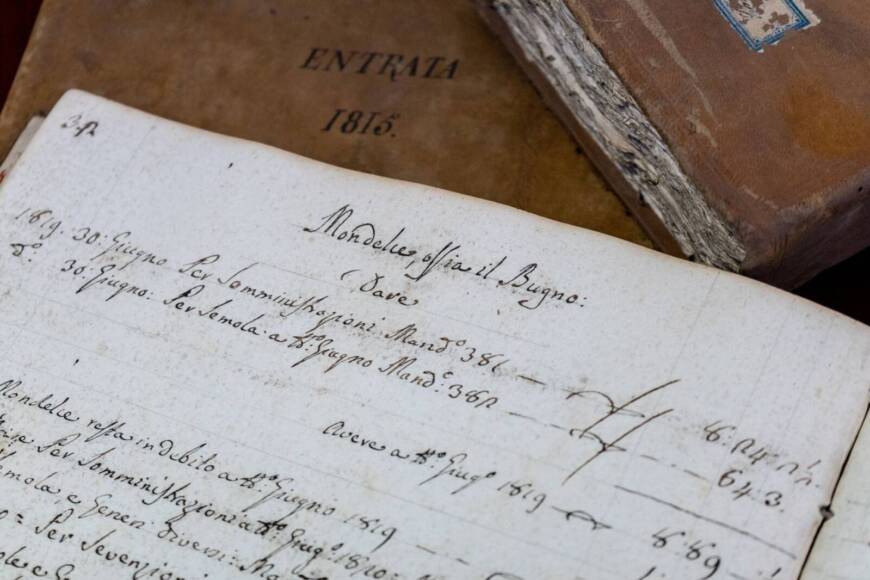
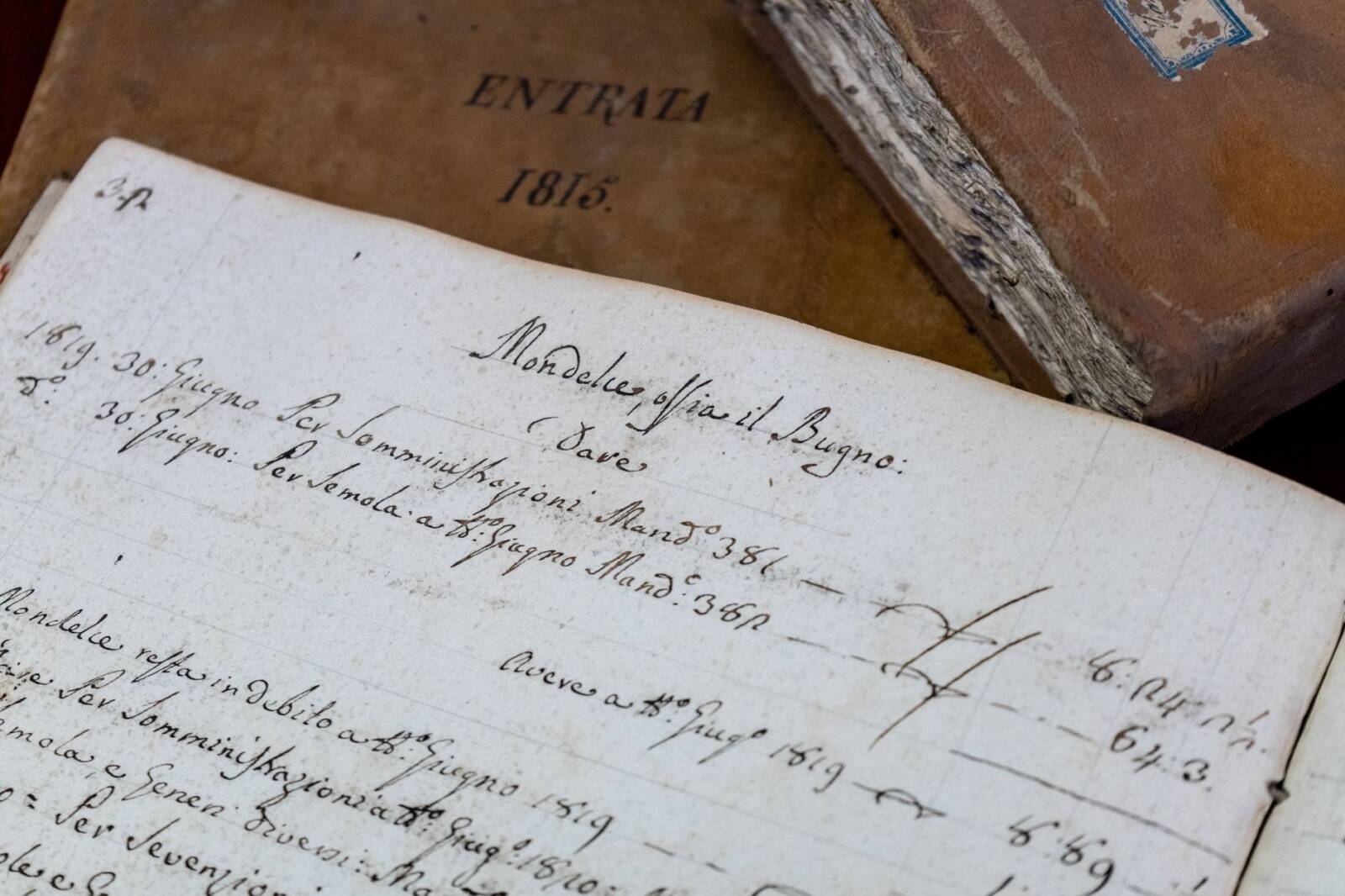
The watermarks of old paper are the secret signature of bygone mills. A mark traced with a brass wire that, when viewed by transparency, reveals who made the sheet and often to within a few years. Reading a watermark correctly can sometimes add two centuries of precision to a bibliographic record. Here is the method we apply to our pieces, without a laboratory, using only a lamp and a little patience.

A watermark is a mark impressed into the wet pulp as the sheet is formed. The papermaker sews a brass wire, bent into the shape of a design or letters, onto the mould: a sieve made of tightly stretched parallel wires (the laid lines) held by more widely spaced cross wires (the chain lines). As the pulp settles on the sieve, it is slightly thinner where it lies over the wire. When viewed by transparency, this area appears lighter. That is a watermark.
The technique originated in Fabriano, in the Italian Marches, at the end of the 13th century. Paper historians date the earliest known watermarks to the years 1280–1290, in the form of simple motifs (crosses, letters, monograms). Italian mills were then seeking to distinguish their papers from those of the Arab world, which never bore watermarks. The process reached France in the 14th century and spread throughout Europe. From the royal decree of September 1739, French mills were required to watermark the name of their province (Auvergne, Limousin, Angoumois) and, gradually, the name of the mill and a date. One can literally read “AUVERGNE 1742” within the sheet.
First rule, non-negotiable: never wet an old leaf, and never fold it to see better. Keep the book flat and work with the light. Four techniques are used.
In the bookseller's practice, raking light photography with a simple architect's lamp yields remarkable results. This is the method we use for the detailed entries in our catalogue of rare books.
Motifs are not distributed randomly. Each region, each mill, and sometimes each master papermaker has a repertoire that evolves slowly. Knowing these families helps pre-orient dating even before consulting a reference work.
| Family | Dominant period | Production areas | Clues |
|---|---|---|---|
| Cross, Gothic letters | late 13th – c. 1400 | Fabriano, northern Italy | Simple outlines, thick wires, wide laid lines |
| Bell, anchor, balance | 14th – 16th century | Italy, southern France | Motifs often topped with a star or cross |
| Jug, vase, fleur-de-lys | c. 1500 – 1700 | Champagne, Comtat Venaissin, Auvergne | Master papermaker’s initials on the jug |
| Grape, bunch | 17th – 18th century | Auvergne, Angoumois, Limousin | Gave its name to the ‘raisin’ format |
| Coat of arms, heraldic shields | 16th – 18th century | France, Netherlands, Germany | Often those of towns or royal privileges |
| Horn, lion, mill name | 1739 – 19th century | Entire France, after royal decree | Province name in full, sometimes year |
A watermark travels with its countermark: a second motif, often the papermaker’s initials or a year, placed on the other half-sheet. The watermark + countermark pair significantly narrows the range of candidates in reference works. Many novice bibliographers overlook it and miss the identification.
Three works still structure research today, and all are available online. This is one of the rare areas of bibliophily where amateurs have access to the same tools as a heritage librarian.
Briquet, Les Filigranes (Genève, 1907) remains the standard reference work for the medieval period and the Renaissance, up to around 1600. Charles-Moïse Briquet spent decades scouring European archives and published a dictionary of over 16,000 facsimiles, arranged alphabetically by motif. The digitised edition is available on Internet Archive; it is navigated by watermark number rather than page.
Heawood, Watermarks, mainly of the 17th and 18th Centuries (Hilversum, 1950) takes over for the following two centuries: approximately 4,000 watermarks reproduced at actual size. Original print run limited, but widely distributed in libraries and accessible in digitised form.
Piccard, Wasserzeichenkartei (Hauptstaatsarchiv Stuttgart) is the world’s largest collection, freely accessible online at piccard-online.de. Several tens of thousands of records covering crowns, ox heads, towers, letters, scales, anchors, horns, and keys. Gerhard Piccard demonstrated that an exact match between a dated watermark and one to be dated often narrows the range to a few years.
Since the late 2000s, the portal Bernstein – The Memory of Paper has aggregated these reference works and several dozen other European databases into a single search interface. For a bookseller, it has become an everyday tool.
Let us be honest about what can be expected. A watermark well identified in Briquet or Piccard generally provides a production window of five to twenty years for the design itself. However, a sheet may lie in storage before being printed or written on. The cautious rule in material bibliography holds that paper is used within ten years of manufacture, sometimes longer for high-quality stocks or bindings.
That said, the watermark remains the strongest argument in several very concrete situations. To distinguish an original edition from a later reprint, the watermark often settles the matter where typography is ambiguous. To date an anonymous manuscript, it becomes the only objective material evidence. To spot a facsimile or a forgery, a watermark dated after the alleged publication date kills the case instantly. This is why we systematically check the watermarks of major pieces before purchase.
Before 1739, it is the initials and accessory motifs that betray the workshop. A pot surmounted by a fleur-de-lys with the letters I HONIG points to the Honig family of Zaandam, major Dutch exporters; a bunch of grapes with the word “FIN” usually comes from Auvergne, around Ambert or Thiers. After 1739, the royal decree makes identification easier: the province—and soon the mill—can be read directly on the sheet.
This traceability has a direct impact on the value in bibliophily. A text printed on Dutch wove paper with a watermark can easily cost twice as much as a print on ordinary laid paper, and a large-sized paper with a prestigious watermark (Whatman, Auvergne) often forms the central point of the argument when appraising an old book.
A watermark is never read in isolation. It must be cross-referenced with the laid lines and the sheet’s format to validate dating. Laid lines spaced more than 1.5 mm apart indicate paper likely produced before the mid-18th century; thereafter, improvements in moulds tightened the mesh. The presence or absence of wove paper (developed by James Whatman in the mid-18th century) is another strong marker, to be corroborated with our article on the difference between laid and wove paper.
The format names found in booksellers’ descriptions—raisin, jésus, cloche, couronne, grand aigle—originate directly from the watermarks that identified them. Knowing these marks allows one to read this technical vocabulary effortlessly and better understand the history of old papers within the book trade.
If you inherit a library and are unsure of a book’s date, don’t try to master Briquet in an evening. Photograph the watermark under raking light, note the dimensions, and send us the image via our free appraisal service. We’ll tell you within hours what the sheet reveals.
No. Medieval Arabic papers never do. European papers from Fabriano onward often do, but not systematically, especially for common grades. A paper without a watermark is not inherently suspicious—it’s simply one less clue.
Very rarely. Reproducing a watermark requires making an entire mould and then a full sheet: an enormous task for a forger, who would prefer to imitate a binding or typography. However, 19th-century facsimiles sometimes reproduce old watermarks. In such cases, the quality of the pulp and the laid-line mesh betray the operation.
First, identify the iconographic family (pot, bunch of grapes, bell, coat of arms, letters). Measure the watermark precisely (height, width). Note the distance between the chain lines. With these three pieces of data, the Bernstein portal usually narrows the search to a few dozen candidates, which can then be compared visually.
Rarely on its own. It provides a production timeframe for the sheet within a few years, but the sheet may be used several years later. It is always cross-referenced with typography, binding, and, when available, provenance marks.
No. An LED architect’s lamp, a camera (even a recent smartphone), a north-facing window, and a little patience are sufficient for 90% of cases. The rest depends on the eye and free online references.
Doubtful watermark, uncertain edition, library to evaluate after inheritance: we examine the papers, bindings, and provenance marks before proposing a price. Request an appraisal or browse our catalogue of antique books.
Tell us what is not working, we fix things quickly. The page you are on is attached automatically.