0
0€
Your cart is empty
You have no items in your cart

The corners are the four corners of the boards. Typical wear areas, they are described by degrees: slightly bumped corners, rubbed corners, worn corners (the board shows through the leather). On fine bindings, corners may be reinforced with metal — a practice used in medieval monastic bindings and some private library bindings of the 17th century.
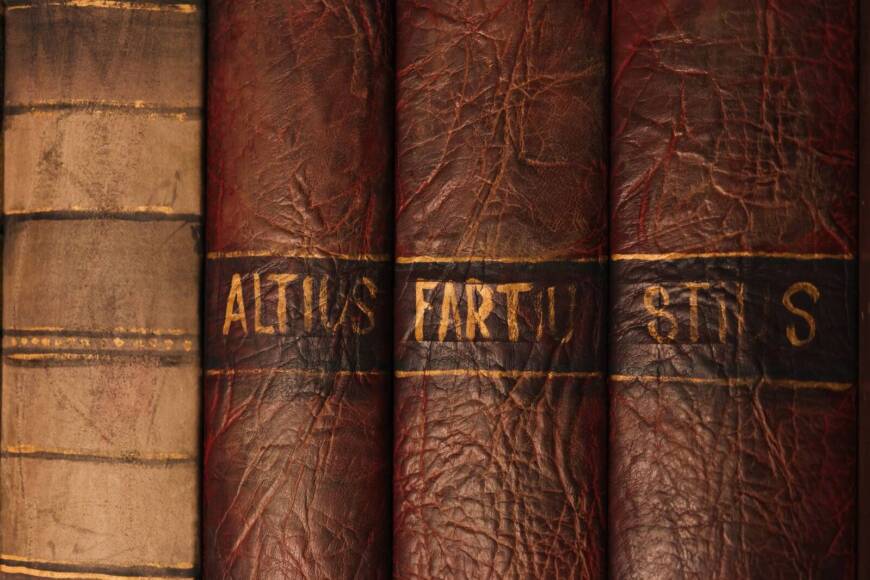
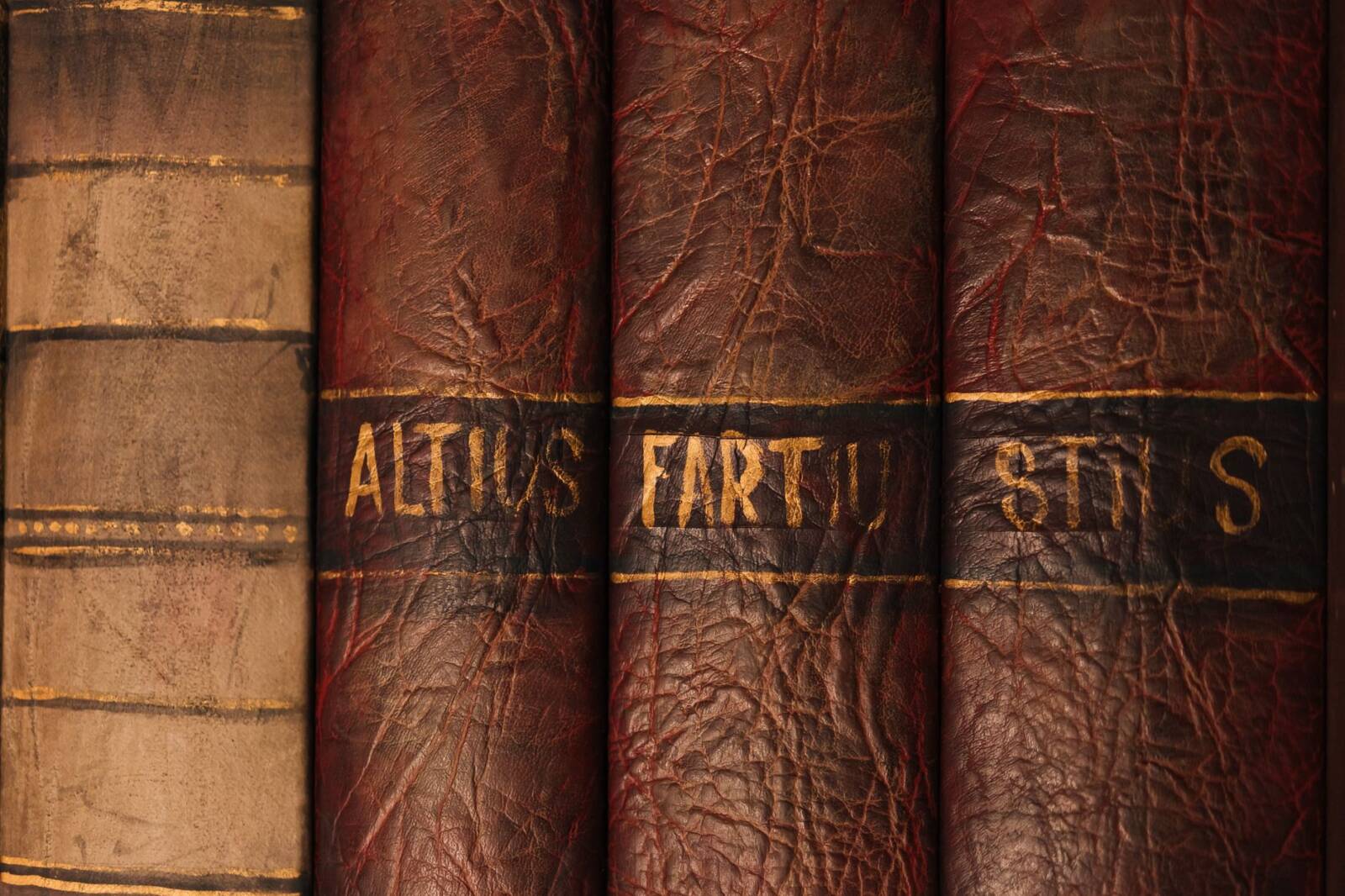
The spine of an old book is not smooth. It features transverse ridges called raised bands, which correspond to the cords on which the gatherings were sewn. In carefully crafted bindings up to the 19th century, these were true sewing supports made of hemp cords (the original "raised bands" of leather soon disappeared). In cheaper bindings, the binder glues strips of cardboard to simulate these raised bands: these are known as false raised bands. A spine with six raised bands remains visually a six-band spine, but the structural integrity differs, and an experienced eye can spot the difference when examining the spine.
The spaces between two raised bands are called compartments or panels. It is here that the binder applies gold tooling: central tools, corner tools, or all-over patterns. One panel is usually wider than the others and accommodates the title piece (often in red or green morocco), while another holds the volume number piece for multi-volume sets. A useful dating clue: in the 17th century, central tools dominate each panel; the 18th century sees the introduction of pomegranate flowers and rococo motifs; in the 19th century, panels become more geometric in the work of renowned binders such as Trautz, Cuzin, and Marius-Michel.
Close the book. The three faces other than the spine expose the edges of the text block: head edge at the top, fore-edge opposite the spine, and tail edge at the bottom. The head edge collects dust — it is almost always the dirtiest part of an old copy. To protect it, gilding has been applied since late Antiquity, hence the term "gilt head" found in catalogues of the NRF or the Pléiade.
Edges come in various styles: sprinkled (speckled with colour), combed (patterns mimicking marble), marbled, gilt, chiseled, or painted. Painted edges with hidden scenes (visible only when fanning the text block) are an English specialty of the 18th and 19th centuries, highly prized by collectors. Further exploration of this topic can be found in the article on gilt, painted, and chiseled edges and their dating.
Now open the book to 90°. You will see the two hinges: the fold area between the spine and each board. Upper hinge on the first board side, lower hinge on the second board side. This is the part most prone to wear—each opening stresses it. A hinge described as “cracked,” “split 3 cm,” or “fragile” is a common defect that an experienced book conservator can repair without altering the original binding (see our article on when to entrust an old book to a conservator).
Inside, the hinge extends into the joint: the area where the flyleaf articulates against the pastedown. “Joint sprung” means the board is still held by the outer leather, but the inner structure is detached. A book with both joints sprung is said to be “loose”: the binding has lost all cohesion.
The hinge is exterior (visible at the joint between spine and board), the joint is interior (between pastedown and flyleaf). Both work together. When a bookseller notes “fragile joints,” expect a discount of roughly 15 to 30 % compared to a flawless copy, adjusted for rarity.
On the inner face of each board lies the pastedown. It is the lining of the board, traditionally marbled paper, decorated endpaper, or, in fine bindings, moiré silk, tabby, or maroon morocco—then called a “lined binding,” a hallmark of Padeloup, Derome, and later Trautz. The pattern of the pastedown often helps date an unsigned binding: marbled papers follow a fairly strict typology by decade.
Facing the pastedown is the first free leaf: the flyleaf. A well-cared-for binding includes several endpapers: blank leaves, marbled endpaper glued to the pastedown, flyleaf, and a protection leaf before the title. Bibliophiles always check that the endpapers are original. “Renewed endpapers” indicate restoration, sometimes old (19th c.), sometimes recent. This is neutral in itself but should be noted.
A marker may be sewn at the head of the spine: a silk or fabric ribbon, sometimes two markers of different colours on missals and books of hours.
Look at the book block from the head, at the spine’s joint. You will see a small braided ridge of coloured thread: the headband. It is hand-sewn, traditionally in two alternating colours of silk, and serves three purposes: to reinforce the sewing of the gatherings at head and tail, to prevent dust from entering the spine, and to protect the joints. On 19th-century industrial bindings, the headband becomes a simple glued ribbon—less sturdy, less attractive, and prone to lifting. The detail deserves its own article: see headbands, raised bands and sewing of the old book.
| Term | Location | What to check |
|---|---|---|
| Boards | Outer faces of the closed book | Scuffing, stains, damp, leather flaking |
| Spine | Part joining the two boards | Sun-bleaching (browning), legible title, joints intact |
| Joints | Edges of the spine (head and tail) | Worn, missing, restored, intact |
| Corners | Four outer corners of the boards | Rounded, rubbed, exposed, restored |
| Joints | Outer hinge (spine/board) | Split, fragile, re-backed, sound |
| Hinges | Inner hinge (board/endpaper) | Broken, weakened, reinforced |
| Raised bands / false bands | Transverse ridges on the spine | True (sewn) or simulated (glued-on cardboard) |
| Panels / compartments | Spaces between raised bands | Gold tooling, floral motifs, title and volume labels |
| Edges | Three trimmed edges of the text-block | Gilt, sprinkled, marbled, painted, soiled |
| Endpapers | Blank leaves at front and back | Original or renewed, marbled or plain |
| Paste-down | Inner face of the board | Marbled paper, silk, lined morocco, pasted-in ex-libris |
| Headband | Braided ridge at head and tail of spine | Hand-sewn (old) or glued (industrial) |
What is the difference between hinges and joints? The hinge (mors) is external, visible when the book is closed, at the junction of spine and board. The joint is internal, between the board and the free endpaper. Both can fail independently.
Is a binding with “false raised bands” of lesser value? Not necessarily. Many Romantic-period bindings from the 19th century and quality half-bindings feature intentional false raised bands. What matters is coherence: fine leather, careful decoration, and a well-proportioned spine count for more than an awkward binding with true raised bands.
Is “worn headcap” or “missing headcap” a deal-breaker? No, but it reduces value. On a common title, a worn headcap results in a 20–40 % discount. On a sought-after rarity, the collector may overlook it. The risk is further damage: a worn headcap weakens the spine, which may eventually split.
Should endpapers be replaced if stained? It depends. For a working copy, yes. For a collectible item, no: original endpapers, even if spotted, are preferable to replaced ones. The golden rule of rare book restoration: intervene as little as possible.
Where can I find the full vocabulary? The La Librairie Antique glossary provides these terms with examples. For deeper study, the BnF publishes technical sheets on historic bindings, and the IFLA sets bibliographic description standards.
The vocabulary above is first used to read catalogues and sale notices. It then helps describe a book you wish to sell. In between, it helps assess what you hold. If you have a volume bound at home and are unsure of terms — headcaps, hinges, original or renewed endpapers — the simplest solution is to bring it in or send photos.
Request a free estimate for an antiquarian book — La Librairie Antique examines each volume using the criteria outlined here and returns a reasoned price range within 48 hours.
Tell us what is not working, we fix things quickly. The page you are on is attached automatically.