0
0,00€
Votre panier est vide
Vous n'avez aucun article dans votre panier


VENDU
Authenticité garantie
Chaque ouvrage est examiné et décrit individuellement par nos soins. Libraire professionnel depuis 1995.
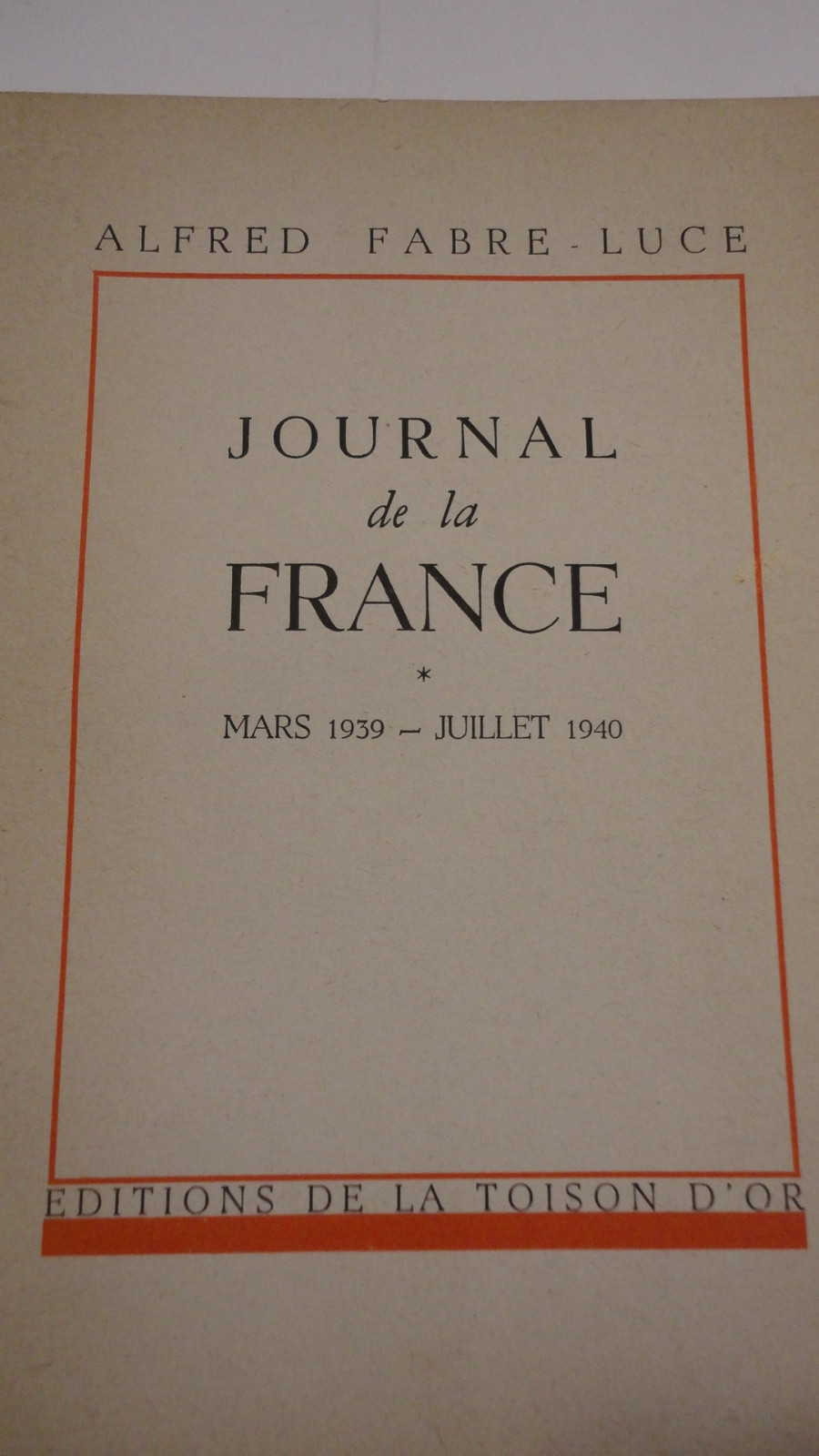
Fabre-Luce, Alfred Journal of France. March 1939 - July 1940 The description of this item has been automatically translated. If you have any questions, please feel free to contact us. Fabre-Luce, Alfred Journal of France. Mars 1939 - July 1940 la Toison d'Or, Brussels, 1942, 352 pp., brooch, in 8, a few sentences underlined in pencil. The Invasion. The bombing…
Lire la description complète ↓Fabre-Luce, Alfred Journal of France. March 1939 – July 1940
The description of this item has been automatically translated. If you have any questions, please feel free to contact us.
Fabre-Luce, Alfred Journal of France. Mars 1939 – July 1940
la Toison d’Or, Brussels, 1942, 352 pp., brooch, in 8, a few sentences underlined in pencil. The Invasion. The bombing of Paris. The Battle of Dunkirk. The Italian Intervention. The disorder. The Armistice. Hendaye, Bordeaux Vichy. Wisdom of Pétain. Etc.. Good copy xA0Edmond Fabre-Luce was In 1919,xA0 stationed in London as an embassy attaché. A year later, he decided to return to Paris to begin a career as a journalist. He began to publish articles in different newspapers then devoted himself to writing political and literary works. A committed witness, he is known for his polemical tone and his non-conformist opinions. Observers sometimes liken him to the non-conformists of the 1930s or associate him with the truant right. After a trip to the Soviet Union, he denounced the living conditions and political events of the new USSR… between 1934 and 1936 he became editor-in-chief of L’Europe nouvelle. From 1936, his articles were openly critical of the policies of the Popular Front. First involved in neo-socialism, he was elected general councilor in 1935 and ran under the label of the Republican Socialist Union in the 1936 elections, without success, before moving closer to the French Popular Party (PPF) of Jacques Doriot. In 1936 he became director of the newspaper L’Assaut, a weekly that was very critical of the Popular Front. He supports Marshal Petain’s policy but condemns compulsory labor service. Favorable to cooperation with the Allies, he predicted German defeat, which led to his being arrested by the Gestapo and imprisoned for four months. In the summer of 1944, the Vichy government had him arrested again. After the Liberation, he resumed his activity as a writer and published political books linked to current events, notably on the Algerian war, on de Gaulle, Valery Giscard d’Estaing and even on Francois Mitterrand. Concerning the general, he notes that the new edition of his book Vers l’armee de metier, published in Algiers in 1943, includes additions on the tank-plane association absent in the 1934 edition: the aim was to strengthen the prophetic role of his writings. Subsequent editions will remove this change. This controversy will land its author in serious trouble later. Favorable for the return to power of General de Gaulle in 1958, he fought the independence of Algeria. In 1962 he published an essay polemic, High Court, in which he accuses the head of state of having violated the Constitution. His book was seized by the police prefect Maurice Papon, then banned and destroyed for offending General de Gaulle. (thanks Wikipedia)
la Toison d’Or, Brussels, 1942, 352 pp., brooch, in 8, a few sentences underlined in pencil. The Invasion. The bombing of Paris. The Battle of Dunkirk. The Italian Intervention. The disorder. The Armistice. Hendaye, Bordeaux Vichy. Wisdom of Pétain. Etc.. Good copy xA0Edmond Fabre-Luce was In 1919,xA0 stationed in London as an embassy attaché. A year later, he decided to return to Paris to begin a career as a journalist. He began to publish articles in different newspapers then devoted himself to writing political and literary works. A committed witness, he is known for his polemical tone and his non-conformist opinions. Observers sometimes liken him to the non-conformists of the 1930s or associate him with the truant right. After a trip to the Soviet Union, he denounced the living condi
LA LIBRAIRIE ANTIQUE
Librairie indépendante depuis 1995, Paris
Expédition mondiale · en cours d'adhésion SLAM[*]
[*] Adhésion au Syndicat de la Librairie Ancienne et Moderne en préparation.
Dites-nous ce qui ne fonctionne pas, nous corrigeons vite. La page où vous vous trouvez est jointe automatiquement.