0
0,00€
Votre panier est vide
Vous n'avez aucun article dans votre panier


VENDU
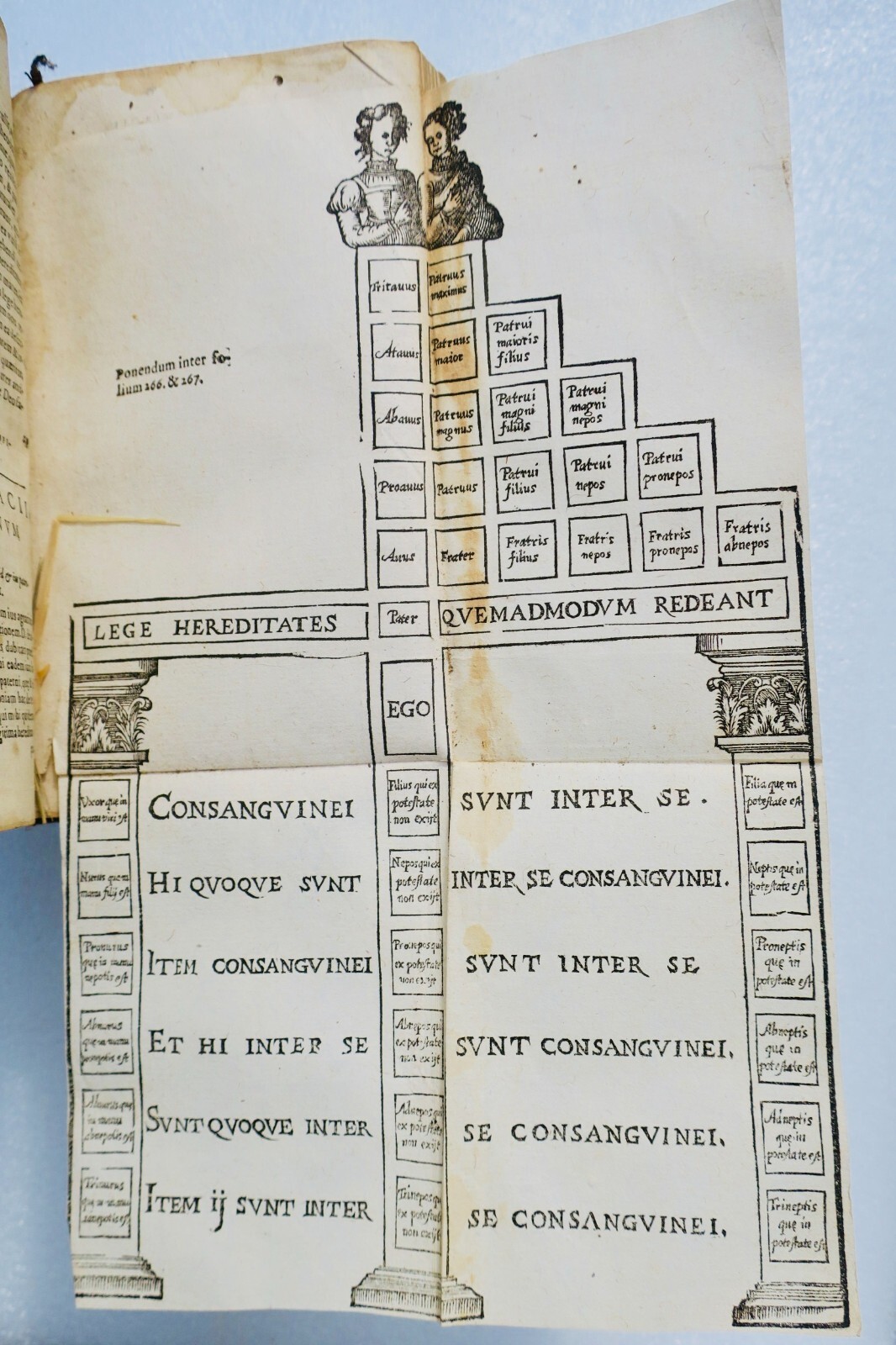
Iacobi CUIACII praeclarissimi observationum et emendationum libri XXIIII Quibus multa in iure corrupta & non intellecta restituuntur, eiusdem de origine iuris ad Pomponium commentarius, accesserunt praeterea indicia duo copiosi, legum vnus, alter verborum & rerum, sentiarum insignium Coloniae Agrippinae, Apud viduam Ioannis Gymnici sub Monocerote, 115 x 175 x 100 mm., contemporary full leather binding, (missing, blunt corners), 48 ff.,…
Lire la description complète ↓Iacobi CUIACII praeclarissimi observationum et emendationum libri XXIIII
Quibus multa in iure corrupta & non intellecta restituuntur, eiusdem de origine iuris ad Pomponium commentarius, accesserunt praeterea indicia duo copiosi, legum vnus, alter verborum & rerum, sentiarum insignium
Coloniae Agrippinae, Apud viduam Ioannis Gymnici sub Monocerote, 115 x 175 x 100 mm., contemporary full leather binding, (missing, blunt corners), 48 ff., 1231 pp., some pale halos in the upper margins, small galleries of verses in the upper margins from page 100 to page 350.
Jacques Cujas, born Cujeus, also known under the Latinized name of Jacobus Cujacius, is a jurisconsult French, born in Toulouse in 1522 and died at Bourges October 4, 1590. It is one of the main representatives of thelegal humanism.
Jacques Cujas was born in 1522. He is the son of a sheet shearer Pyrenean originating fromOloron-Sainte-Marie established in Toulouse. His wealthy family allowed him to do his humanities, then study law. He follows in particular the lessons ofArnaud Du Ferrier, professor of Roman law trained in Padua with Michel de L’Hospital. He completed most of his law studies between 1537 and 1544.
Between 1547 and 1554, he taught at the faculty of Toulouse as “ halberdier » an introductory course on Institutes of Justinian.
He received the support of major Toulouse parliamentary families and accepted the tutorship of the two eldest sons of Michel Du Faur, judge-mage in Toulouse; one of the sons becomes the famous jurist Pierre du Faur de Saint-Jory.
In 1554, he aspired to the chair of Roman law in Toulouse but the competition saw the appointment ofEtienne Forcadel, who became a professor in 1557. Also, he prefers to accept a chair at theUniversity of Cahors, a small satellite university where many Toulouse lawyers cut their teeth. Antoine de Govea, brother of the founder of College of Guyenne of Bordeaux (1534), held a chair there until 1554 and his work reinforced Cujas in his efforts to restore authentic Roman law by returning to the sources. It was in Cahors that he published his course taught in Toulouse: Notes on the rules ofUlpian (1554). His career was then marked by numerous peregrinations.
There is little left in Cahors and he leavesUniversity of Bourges (1554-1555), which was then the center of thelegal humanism in Europe, to succeed François Baudouin. His protectors Michel de l’Hospital, Arnaud Du Ferrier and Barthélemy Faye recommended him to the Duchess of Berry Margaret of France. But the appointment of Cujas to Bourges harmed local candidates, resulting in student unrest which forced him to retire to Paris in 1557. After three months, he joined theuniversity of Valencia in November 1557, interested in annual salaries of 600 livres. During this first stay in the city, he married Madeleine Du Roure, daughter of a doctor Jewish from Avignon, and binds himself with the bishop Jean de Monluc.
At the death of dean Le Douaren, Marguerite of France recalled him to Bourges where he then experienced a second calm and fruitful period, and published from 1560 to 1566.
In 1566, at the request of Marguerite de France, then Duchess of Savoy and Berry, he crossed the Alps to teach at theuniversity of Turin (1566-1567), replacing Antoine de Govea who had just died. He returned to Valencia the following year. From 1567 to 1575, Cujas enjoyed great fame at the Faculty of Valencia, newly united with that of Grenoble. He has the first chair and undisputed authority over all legal teaching. He is also an honorary advisor to the parliament of Grenoble.
In 1575, religious wars devastated the country. Cujas, who certainly belonged to the Calvinist religion during his second stay in Bourges, took refuge with Antoine de Crussol, leader of the Protestants of Languedoc and Dauphiné during the first civil war (1562). He then left for Paris where the king exceptionally authorized him to give a few courses in Roman law to issue diplomas. Indeed, to favor the teaching of canon law necessary for the training of clerics, Roman law has been prohibited since the 14th century.e century. He will then return to Bourges.
His last years were poisoned by the fear of League which requires professors to make statements favorable to its policies.
After the death of his wife, Madeleine du Roure and his son, he remarried in 1586 with Gabrielle Hervé, niece of the diplomat Guillaume Bochetel, and with whom he has a daughter, Suzanne Cujas. Ironically, the Bochetel family, Suzanne’s guardian, contested Cujas’ will during the remarriage of Gabrielle Hervé in 1592 to Godefroy de Cullon. He died on October 4, 1590.
Thank you WIKIPEDIA
In 1554, he aspired to the chair of Roman law in Toulouse but the competition saw the appointment ofEtienne Forcadel, who became a professor in 1557. Also, he prefers to accept a chair at theUniversity of Cahors, a small satellite university where many Toulouse lawyers cut their teeth. Antoine de Govea, brother of the founder of College of Guyenne of Bordeaux (1534), held a chair there until 1554 and his work reinforced Cujas in his efforts to restore authentic Roman law by returning to the sources. It was in Cahors that he published his course taught in Toulouse: Notes on the rules ofUlpian (1554). His career was then marked by numerous peregrinations. There is little left in Cahors and he leavesUniversity of Bourges (1554-1555), which was then the center of thelegal humanism in Europe, t
LA LIBRAIRIE ANTIQUE
Librairie indépendante depuis 1995, Paris
Expédition mondiale · en cours d'adhésion SLAM[*]
[*] Adhésion au Syndicat de la Librairie Ancienne et Moderne en préparation.