0,00€


Description
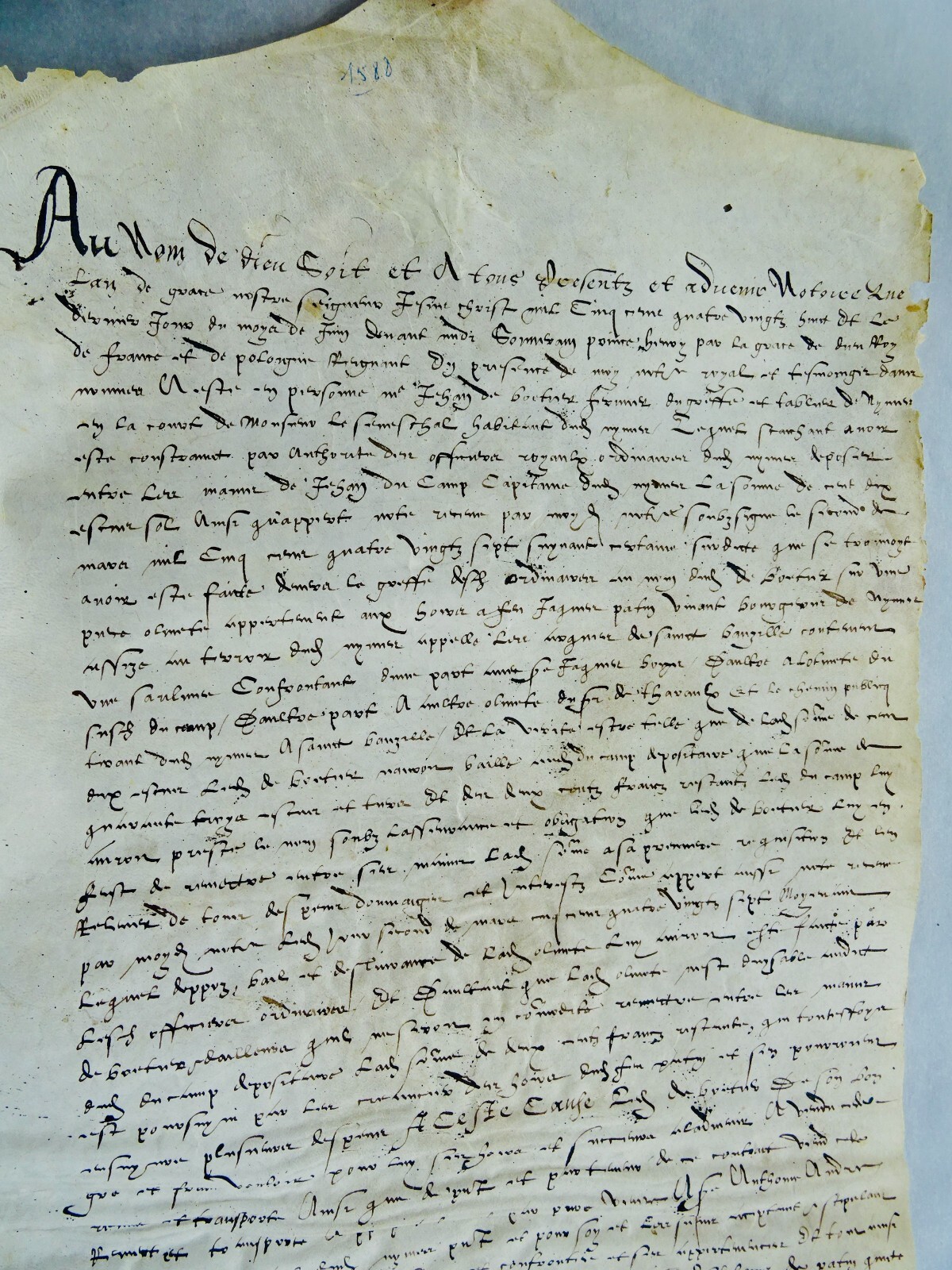
Sale by Jehan de Boetier to Anthoine André, of an olive grove located in Nîmes, for the price of 100 crowns, before Antoine Sabatier, notary of Nîmes, on June 30, 1588.
1 piece of parchment composed of four parts glued together, 0.29 x 2.13 m, 223 lines, very good general condition. “Purchase and remission for Mr. Anthoine André, merchant living in Nymes […]. » [XVIe s.] ; “De Colvede de Saint-Bausile” [XVIIe-XVIIIe s.].
On June 30, 1588, under Henry III, « king of France and Poland », Jehan de Boetier, resident of Nîmes, clerk to the seneschal of Beaucaire and Nîmes, sold to Anthoine André dit Le Redon, merchant, resident of Nîmes, an « olivete belonging to the estates of the late Jacques Patin, living bourgeois of Nymes, seated in the terror dud. Nymes, called Les Arques de Sainct-Bauzille, containing a saulmée, confronting on the one hand with Sir Jacques Boys, on the other hand with the olivete of the aforementioned [Jehan] Du Camp, on the other hand with another olivete of the Sieur de Thavaulx and the public road leading from the said Nymes to Sainct-Bauzille. »
The act was carried out “in the house of Mr. Jehan Nicole, where Mr. Anthoine Gally, doctor and lawyer, lives. Present icelluy Gally, master Pierre Mazel, practitioner, and Jehan Tourel, dyer, residents of the said Nymes, and me Anthoine Sabatier, royal notary of the said Nymes. »
The sum of 100 crowns is given to Jacques Cassaignes, treasurer of the King: Jehan de Boetier is in fact forced by judicial decision to pay the arrears of a debt of 110 crowns that he owes to Jehan Du Camp, captain of Nîmes ( Mars 2, 1587).
Other mentions: master Pierre Requete, husband of Anne Combes, inhabitants of Sommières; Anthoine Tesser, fashion designer, husband of Jehanne Combes, sister of the previous one; master Pierre Thomas, practitioner, resident of Sommières; Jehan Robin, trimmer, resident of Sommières.
1 Measurement of land area, from 6000 to 8000 m2.
2 Anthoine Sabatier was a member of the consistory of Nîmes in 1596 (Albert Puech, A city in times gone by, or Nîmes at the end of the 16th centurye century, according to the composition of 1592 and unpublished documents, Nîmes, Grimaud, 1884, p. 194; and Jacques Boulenger, Protestants in Nîmes at the time of the Edict of Nantes, Paris, Fischbacher, 1903, PJ Arch. of the consistory of Nîmes, B 90, t. VII, fol. 25). The notarial minutes of Antoine Sabatier are deposited in the Departmental Archives of Gard, 2E 37, 1557-1595 (in particular the register 2E 37/74 for the years 1587-1588).
3 The seneschal is an officer of the royal administration whose functions are particularly judicial. The seneschal of the Beaucaire jurisdiction had his residence in Nîmes. In 1588, it was Jacques de Baches de Beaux (New Research to help with the history of the town of Beaucaire, Avignon, Imprimerie de Seguin elder, 1836). Jacques Cassaignes is treasurer and ordinary receiver of the King’s domain in the seneschal of Beaucaire and Nîmes (François Dumont, Inventory of decisions of the Privy Council, reigns of Henry III and Henry IV, Paris, Editions du CNRS, 1971-1978, t. 1, Reign of Henry III).
4 Gard, arr. Nîmes, intercom. Country of Sommières.
On June 30, 1588, under Henry III, « king of France and Poland », Jehan de Boetier, resident of Nîmes, clerk to the seneschal of Beaucaire and Nîmes, sold to Anthoine André dit Le Redon, merchant, resident of Nîmes, an « olivete belonging to the estates of the late Jacques Patin, living bourgeois of Nymes, seated in the terror dud. Nymes, called Les Arques de Sainct-Bauzille, containing a saulmée, confronting on the one hand with Sir Jacques Boys, on the other hand with the olivete of the aforementioned [Jehan] Du Camp, on the other hand with another olivete of the Sieur de Thavaulx and the public road leading from the said Nymes to Sainct-Bauzille. » 3 The seneschal is an officer of the royal administration whose functions are particularly judicial. The seneschal of the Beaucaire jurisdictio